Posts

Inculcating Psychological Mindedness for Use After Treatment

As so often happens, a comment on Twitter makes me think of a book I read that may have something useful to offer the conversation. In this case, it was a question about post-treatment goals in and for therapy, and whether they diverge that much between CBT and psychoanalytic practitioners. In particular, it was asked whether both traditions seek to create a capacity for what (following Nina Coltart) I would call a healthy psychological mindedness (a lack of which during intake bodes ill, as she says, and my experience confirms, for successful treatment). 

The question of post-treatment goes back, of course, to Freud's very late essay, "Analysis Terminable and Interminable," and its welcome ambivalence about whether one can ever be truly and totally and completely analyzed. I was very heartened precisely by his ambivalence in this essay. I also found it edifying that Freud seemed to recognize benefits might continue on even after analyst and analysand formally cease to meet together for sessions. 

In this regard, I often think of something Adam Philips (he whose books are so essentially aphoristic in nature) once said, which I have found incredibly true in my own life: "the cure can begin only after the treatment has ended." More recently, he has returned to the whole vexed question of cure in what I think is one of his best and most important books, The Cure for Psychoanalysis, which captures in one place a theme he has often advanced in just about every one of his previous books: about the sad irony that psychoanalysis has become--in many places, not least training institutes--a hidebound ideology instead of a means to free people from the prison of ideologies. 

For me, my first analysis (four times a week on the couch for almost seven years) ended in late July 2000 but I have found myself living from that in some useful ways ever since. And in fact I think the "returns," far from diminishing, actually grew in the years after treatment came to a formal end. (I would say the same thing of my second analytic therapy, which is ongoing.)

One person who has thought about this in an elegant and useful way is Fred Busch in his 2013 book, Creating a Psychoanalytic Mind: A Psychoanalytic Method and Theory.

Busch seems a very interesting fellow, and quietly understated pioneer of some sort. As he recounts in the introduction to this book, Busch was one of the first clinical psychologists to be admitted in the 1970s to psychoanalytic training at an American institute. American institutes, unlike those in Canada, the UK, and parts of Europe and elsewhere, generally have been extremely reluctant to admit any but psychiatrists or those with medical degrees. 

In this, they deplorably and unjustifiably take a different tack from what Freud recommended in The Question of Lay Analysis, a book where Freud memorably says two groups should most certainly keep their hands off psychoanalysis: doctors and clergy! He also coins a memorable phrase about analysts being "secular pastoral workers," a phrase to which I gave some attention elsewhere

I will not go into Busch's entire book, which I encourage everyone to read, but simply make a few brief observations based on notes I took years ago when first reading it.

Busch understands analysis to consist of three phases:

1) The first phase is when the patient comes to be familiar with his own inhibitions and restrictions that keep him from living: until the patient can wonder about his lack of wondering, wondering is not possible. This phase, later in the book, is called one of self-observation. 

2) The middle phase of an analysis is the creation of a "psychoanalytic mind," that is, learning to observe one's own mind and its sequence of free associations. Such a psychoanalytic mind is necessary if the analysis is to bear long-term sustainable fruits in one's life. It is necessary, that is, if the patient is to be freed from the "slavery of repetition compulsion" and instead freed to "think about thinking." Later in the book Busch calls this phase one of self-reflection. 

3) The terminal phase of an analysis consists of a deeper psychoanalytic mind more completely free from deceptions in understanding one's associations with greater veracity. Here the analysand can "play, muse, reflect, and interpret her own associations." This phase Busch later calls self-inquiry. 

Busch says that part of his practice consists in seeing patients for a second analysis. They have benefited from their first analysis, but from that largely derived only knowledge of their unconscious--an "object," as it were, rather than a process. And for Bush, "the process of knowing is as important as what is known." This, for me, is the very obvious difference between my first analysis (which I wanted simply to know what was unconscious and bring it forth for rational scrutiny and, especially, control!) and my second, which has focused much more on the process of knowing and far less on the contents. 

Busch continues in this vein, saying that he offers a different goal for analysis which, classically, has held up the importance of a state of knowing rather than a process of knowing. In the former, we come to know consciously what was previously unconscious. In the latter, the patient gains an understanding of how his mind works and how it affects him. Both offer freedom, albeit of a different degree and type, but Busch suggests the freedom of a psychoanalytic mind, with a process of knowing--in addition, and perhaps even preferable, to--what is known, may be of greater long-term benefit. I would heartily agree. 

A Note on Four Psychoanalytical Biographies

I have been a tireless reader of biographies at least as far back as the seventh grade. Since the summer began, I've had a chance to read four biographical studies, none exhaustive, and each in most cases covering terrain I was at least moderately familiar with. But they were enjoyable nonetheless, each in their own way, and each also filled in some gaps in a welcome way, so I thought I'd offer a few notes on each in case others might wonder about the wisdom of picking any of these up.

I begin with Joel Kanter, ed., Face to Face with Children: The Life and Work of Clare Winnicott. I should confess two biases at the outset: first, anything with the word "Winnicott" in the title is invariably going to attract my attention. Second, Joel Kanter is one of the conveners of an international study group on psychosis that it has been my very great privilege and delight to be part of.

That said, this book fills a huge lacuna. Clare Winnicott's husband Donald Woods is of course world renowned. But her own life as a clinical social worker and writer has been largely left in his shadow, which is completely unjustifiable given the scope of her contributions in their own right--to say nothing of the huge and countless ways she helped her husband achieve so much. 

Kanter has assembled a worthy cast of people to write about her works, and has reprinted several of them which were originally published decades ago in obscure places. But the crowning glory of this book is the 90-page biography he writes at the outset, which is superb. Buy and read the book if only for that reason. 

I have been very interested in reading more of Sandor Ferenczi for some time, and recently stumbled across Sandor Ferenczi: Reconsidering Active Intervention by Martin Stanton. It is a unique book: in fact I would call it a prolegomenon to a proper scholarly biography. That diminishes Stanton's labours not a whit, and in fact he himself more than once says he is merely trying to lay out the parameters of what a full biography of Ferenczi needs to wrestle with. 

There are at least two significant gifts offered by this book. First, Stanton has performed a very great task by merely assembling a chronology of the Hungarian analyst's life, farcing into each entry not just significant events in Ferenczi's own life, but also significant developments in the wider psychoanalytical movement in the opening decades of the last century. Thus we see when and where Freud and Ferenczi first meet, and Jung and Ferenczi, and so on.

Second, he has put together thematically named chapters that introduce the reader to some of the concepts and practices unique to Ferenczi, with liberal quotations of his writings as well as reactions, where known, to his writings from Freud and Jones, Jung and Klein, and others.

Next up is Gérard Bléandonu's Wilfred Bion: His Life and WorksIt is an odd book in some ways, starting with the fact that a French psychiatrist wrote the first biography of an English psychiatrist and psychoanalyst, which was then translated from French. As someone who, many years ago, worked in scholarly translation of works between French and English (dealing, at the time, with Canadian governmental policy on HIV/AIDS), I know what a vastly time-consuming and painstaking process it is. I also learned that it's generally inadvisable to translate from translations. 

Nevertheless, in a way not entirely dissimilar to the Ferenczi study noted above, Gérard Bléandonu has written a life that spends most of its time discussing Bion's texts. I would have welcomed more integration of the theoretical chapters with Bion's life, which seems very much confined to the introduction to the book. By the end of the book one does not feel that one has penetrated very far at all beneath the surface of Bion's life, which is perhaps how he wanted it. 

So I would not consider this the definitive study of Bion by any means, and once again wonder: is anyone working on such a biography? If I had time and money I'd gladly fly to England (and anywhere else!) to luxuriate in archives and private collections of letters and whatever else I could lay my hands on in order to write about Bion. (For some unanalyzed reason, I have long wanted to write a biography. I thought at one time I might do the moral philosopher Alasdair MacIntyre, but a new study of his life has just been published--once more first in French!) 

Finally we come to Brett Kahr, The Legacy of Winnicott: Essays on Infant and Child Mental Health. I picked this up not only because I respect Kahr and have enjoyed previous works of his, but for two other reasons at least: the inclusion of an interview with Winnicott conducted by no less a figure than Paul Roazen; and then a really compelling essay by Susie Orbach, "The False Self and the False Body." 

If you do not know Roazen's work, then you should. He bids fair, more than a decade after his death, to retain (to my mind at least) the post of doyen of historiographers of psychoanalysis, at least in the anglophone world. Several of his books have been utterly fascinating, not least his Freud and His Followers as well as Meeting Freud's Family. 

It was Roazen, if I recall correctly, who back in the 1960s discovered and published the then hugely scandalous fact that Freud had analyzed his own daughter Anna, which by that point almost everyone was at pains to conceal, not least since she didn't die until 1982. On the topic of Anna, I've read two biographies: the one by Robert Coles (which is workmanlike but all of his biographies tend to feel just a shade too beige in some ways) and the more comprehensive one by Elizabeth Young-Bruehl, in an updated second edition from 2008.

I have known of Orbach's work for a while, but not read much. Still her essay in this collection is extremely valuable for its steely eyed critique of Winnicott's ideas of the true and false self. Orbach argues that too much of the reception and use of these ideas by and after Winnicott posit some kind of chasm (bad!) between them, on the one hand, or some kind of magical integration on the other (good!). But, she argues convincingly, we cannot and must not allow them to be seen as thus divided because in reality aspects of the true and false selves are always mixed up with each other. The therapeutic task thus becomes not a perfectionistic one (how very unWinnicottian!) whereby we totally separate or totally integrate the two, but rather an asking of the question: how ought they to be together, and what can be realistically disentangled and perhaps changed, and what cannot? 

In sum, each of these books was interesting, though none, admittedly, was as moving and fascinating as the last major biography I read, Gail Hornstein's lovely study of Frieda Fromm-Reichmann (about which a few brief comments here though I really should go back and write more about her). 

Next up: I will likely shift away from psychoanalytical biographies for a bit as I've just ordered Simon Sebag Montefiore's Stalin: The Court of the Red Tsar. I was tempted to do so after this highly entertaining (can one say that?) interview with the author here

On the 25th Anniversary of Her Death: Nina Coltart on Vocation and Faith in Psychotherapy

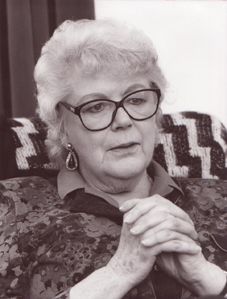
For reasons I will not bore you with, my mind has long had an acute awareness of anniversaries and dates of various sorts. So it dawned on me a week or so ago that next month will mark the 25th anniversary of the death of Nina Coltart, perhaps the one psychoanalyst whose influence on me continues to grow even today--if that is a possible and defensible claim of a woman I never met. I wrote here a bit about how her influence began with me thirty years ago (!!) now, and has returned in very helpful ways as I've gotten back into clinical work after a long academic "detour" as it were.

In being aware of the anniversary of her death, and of all that I feel I still owe her, I began to wonder about writing something to commemorate her death in 1997 on June 24th (death of John the Baptist, which somehow seems significant though not in ways I can defend). But where to publish such a piece, and who would be interested, especially an essay written by a nobody and devoted to someone who only became somewhat well-known in the last five years of her life and has now been gone a quarter-century?

But then all of a sudden this week the psychotherapist and philosopher Kristian Kemtrup on Twitter, who authors some of the most insightful questions and richly reflective discussions on a medium often famed for doing anything but, asked the following:
I’m curious what people think: What are the causes of some therapists finding the job to be unbearable? What causes them to burnout and quit.
How do some therapists avoid this? How do we advise others to help them avoid it?

My instincts in answering that question, as I said on Twitter, went immediately to Coltart, and so I thought I'd post some longer reflections in answer to these questions and by way of reflecting with real gratitude for her life and work. 

If I return to her very often, it is because, I now realize, of three things at least: first, she led me (via her first book Slouching Towards Bethlehem) to take the plunge into a four-times-a-week psychoanalysis on the couch for nearly seven years with the late Dr Louise Carignan. That would change my life in countless ways from which I continue to benefit (as Adam Phillips says, "the cure can begin only after the treatment has ended"). 

Second, Coltart, in the last interview she gave about six months before her death, noted that she was the most independent minded member of the Independent Group within the British Psychoanalytical Society, and she encouraged others to be very true to themselves and very independently minded as well. I have never been a joiner, and long resisted being put into, and putting others into, boxes and categories, so this (somewhat schizoid?) spirit of hers appeals very strongly to mine. 

Third, Coltart has a very practical focus that I find eminently useful on a near-daily basis, and so let me elaborate here four concrete ways I've found, and find, her coming to mind at opportune moments in clinical work with a view to answering Kristian's questions above: survival-with-enjoyment; faith; a strong life outside the consulting room; and vocation. Let me reflect briefly on each. (I will elaborate in much more detail on all four in a book I'm working on.)

Survival-With-Enjoyment:

This is a theme she writes about crisply in her second book, How to Survive as a Psychotherapist. Here she stoutly insists that the notion of 'survival' often seems to mean, at least in a British context, a kind of grim, mirthless carrying on, as in Surviving the Blitz. Instead, she wants to insist--without in the least being pollyannish about it--that the survival of a psychotherapist has to be shot through with enjoyment. She doesn't cite Winnicott here as I expected, but this, of course, is very similar to his claim that one must be able, as both psychotherapist and patient, to play and enjoy each other; I wrote a bit about that here

I wonder if those who find the therapeutic job unbearable or who appear to burn out (I've seen three therapists, all much younger than I, leave the field in the last month alone after less than a decade) from it ever thought that they could, and should, enjoy it. Or was that an impermissible thought? Were there (as Coltart would phrase it) some super-ego elements of guilt or masochism contaminating their ability to enjoy the work? This is entirely speculative and I offer no judgment here at all, not having any intimate knowledge of the people who leave the field. 

But as a full-time academic in psychology who is aware of the (deplorable and often unbelievably vacuous) state of training in undergraduate and graduate programs, I think I am on surer ground in saying that the idea of survival with enjoyment is almost certainly rarely if ever even thought, let along vigorously discussed openly and appreciatively. Students are admitted by universities interested only in keeping students in seats with vague promises of an 'interesting career' in the 'helping professions.' Little is said beyond that, I wager. Certainly notions of 'enjoyment' would be beyond the pale of many who might regard such discussions as impermissible or purely private concerns. 

Faith:

To hope that you not just survive, but also enjoy the work, takes me to the second notion that Coltart unapologetically proffers: faith. This, of course, is an even more 'impermissible' thought in virtually all clinical training programs except, perhaps, those in Christian academic contexts (where the uses and abuses of 'faith' are legion). 

Coltart notes in several places that she was an Anglican (as I was also when I first read her, which perhaps adds an additional reason to the affinity I felt with her) for part of her life before coming out of that to embrace Buddhism. But in any event she would defend the notion of faith, in a non-theological sense, for the rest of her life. For her that is defined as "faith in ourselves and in this strange process which we daily create with our patients." Such faith constitutes, with love, the only "trustworthy container" for the "hatred, rage, and contempt for varying periods of time" that patients might bring (or we in turn might feel). This idea of faith is one where she explicitly cites the influence of Bion, especially his book Attention and Interpretation.

There will be dark and difficult days, setbacks and anger and aggression and hatred in the transference and counter-transference. There will be patients you cannot reach, patients whose progress seems minimal at best. All the while the demands for treatment are relentless across this country and almost everywhere else, and they are only going up. In such a context, all this can be greatly discouraging to those who do not have deep training, their own personal psychotherapy, good supervision, and faith that you can and will make a difference and people can and will get better. Absent these four factors (at least), I can see how people might easily burn out and leave. 

An Extra-Therapeutic Life:

Faith without works--to cite a tedious Reformation debate--is not entirely useless, but it doesn't get you very far in psychotherapy. You need some concrete work and works outside of your consulting room to go along with faith so that both might help you to survive and enjoy the work.

In her last interview, published in the charming collection Freely Associated: Encounters in Psychoanalysis with Christopher Bollas, Joyce McDougall, Michael Eigen, Adam Phillips and Nina Coltart that Anthony Molino put together, Coltart spends some time justifying her decision to not just retire in 1994 but to resign her membership in the British Psychoanalytical Society, which astonished a lot of people and caused some of them to wonder if she wasn't becoming depressed or demented or something. She says quite simply that her life as a psychoanalyst was over, and she had no need of the Society any more, and thus no need for any badges of identity such as membership conveyed. 

Vigorously in retirement, but also in her life decades before that, Coltart enjoyed travel, extensive reading (of anything and everything outside psychoanalysis, she says, which seems key!), gardening, keeping up with friends, and other things. She had a very clear sense of her own life and pursued it with zest outside her consulting room, and bluntly encouraged other therapists to do the same thing as when, e.g., she writes: 

take it seriously when I say that you need to attend with real care to rest, relaxation, and refreshment, wherever you personally find it. Don't let your devotion to the job become too contaminated by superego elements and certainly don't let guilt percolate into any of your forms of relaxation and rest.

If you do these things, she concludes this passage in The Baby and the Bathwater, you will help preserve your ability to see and feel that "we have the most interesting job in the world." 

Certainly for me--whatever that's worth--I have longstanding academic and other interests outside of psychotherapy, and these are not only valuable in themselves, but they are crucial adjuncts in sustaining my faith, my ability to enjoy the work, and my sense of vocation. They 'inoculate' me against some of the vicarious traumatization characteristic of our work, and allow me to return to it refreshed each week. 

Doing clinical work no more than 20 hours a week at most also helps enormously to keep time open for other interests as well as teaching. People who do not have this luxury--as I honestly recognize it to be--who must work 40 or more hours just to try to survive (since the pay in most places, outside perhaps of private practice, is so abysmal) could easily find it harder to stay in this vocation long-term and could burn out sooner.

Vocation: Apart from the above passage, Coltart seldom uses the word 'job,' however. Instead she makes a case in this last book of hers for seeing psychotherapy as a vocation, another traditionally theological term that she removes from that context for her own use, saying that vocation has five features:

  • giftedness
  • belief in the power of the unconscious
  • strength of purpose
  • reparativeness
  • curiosity

I am not at all sure that many training programs today talk about any of these above, let alone see them as worthy goals. My experience in higher education in Canada, Ukraine, and the US has all been within Catholic institutions, so the idea of 'vocation' comes more naturally and easily on such campuses--but beyond them? I'm not so sure.

Nevertheless, for me the idea of vocation--to both teaching and psychotherapy alike--has been absolutely sustaining through brutal cut-backs, devastating loss of morale in the last few years, very poor pay, endless bureaucratic encroachments, pestilential administrators and insurance companies, and other issues. I have looked many times at other 'careers' with much greater pay (Walmart is now paying its truck drivers a starting salary of $110,000 per annum!), but because I enjoy both of my vocations greatly and have faith in the process of teaching and therapy alike, I remain. But if I did not have this sense of vocation, I would have bailed a long time ago and I do not in any way for even a moment blame those who do bail out. 

All these put together--a sense of faith in oneself and the process, a sense of vocation, a sense of enjoyment, and an unapologetic life outside the consulting room--function, for me if for nobody else, as very strong supports to keep doing this difficult and unpredictable work with delight and curiosity and love. (Questions for another time: can these things be made requirements of admission into training programs? Can training programs themselves be restructured to focus on or even inculcate these where lacking?)

Outing Myself as Schizoid:

But there is--again for me if not for others--one other factor here I cannot fail to mention. Let me conclude here with an additional response to Kristian's questions drawn not from Coltart but from someone else I've learned a great deal from and read with real profit and gratitude: Nancy McWilliams (on whom I last wrote at length here). (I like to think she and Coltart would probably have found each other quite compatible in many ways.) McWilliams' paper on schizoid dynamics is, quite simply, the best thing I've read in the literature going all the way back to Fairbairn. It shows what is best and useful and creative about these personality traits and dynamics, and does so in a way that explicitly rejects the pathologizing approach of the DSM. 

In answer to how some therapists avoid being burnt out or driven from the profession, I would, in all honesty, have to say for myself alone that having fairly pronounced schizoid tendencies in the way that McWilliams so brilliantly captures has, in addition to all the foregoing (faith, vocation, etc.), been an unintended gift. When she writes that "psychoanalysis is a profession by schizoids for schizoids," I stood and cheered. And when she further notes that some research out of Australia on the personality dynamics of therapists has revealed that "although the modal personality type among female therapists is depressive, among male therapists, schizoid trends predominate," I again felt gratified and, perhaps ironically, less alone. 

She continues that schizoid types are ideally suited for practicing psychotherapy because they "are not surprised or put off by evidence of the unconscious.  That is, they have intimate--and at times uneasy--familiarity with processes that in most people are out of awareness, an access that makes psychoanalytic ideas more accessible and commonsensical to them than."

Using perhaps more familiar and less freighted terminology, McWilliams continues:

Schizoid people are temperamentally introspective; they like to wander among the nooks and crannies of their mind, and they find in psychoanalysis many evocative metaphors for what they find there.  In addition, the professional practice of analysis and the psychoanalytic therapies offers an attractive resolution of the central conflict about closeness and distance that pervades schizoid psychology.

I could quote acres of her paper but will not. Go and read it--it's very rich and repays regular re-readings--and her equally excellent books

I hope her thoughts, and those of Coltart, along with my own, might be of some use in continuing to reflect upon those excellent questions Dr Kemtrup posed this week. Certainly these thoughts of mine do not pretend to any great wisdom, nor to being any sort of panacea, but perhaps they might at the very least function as a worthy commemoration of and tribute to a psychotherapist and psychoanalyst from whom I have received much. May Nina Coltart's memory continue to be a blessing.

Karen Maroda on Theory, Challenge, and the Therapist's Needs

The Analyst's Vulnerability: Impact on Theory and Practice by Karen J. Maroda (Routledge, 2022, x+215pp.) is such a disarming book. I think that is the most apt word for it.

It advances some potentially challenging if not controversial theses but does so in a cogent, humble way free of fulgurating fireworks and polemics. Indeed I rather think that Maroda, aware of the defensiveness likely to be aroused by some things she advocates, has deliberately written them in as low-key a way as possible. The effect, for me at least, was to make her book more powerful than I was expecting. Indeed, I feel that in at least two important areas it has forced me to rethink some basic assumptions and feel my way towards some changes in my clinical practice. 

I previously wrote about one of her other books, Psychodynamic Techniques, which contains similarly sensible material serenely expressed in useful ways. (I have also read her first book The Power of Countertransference, which was decent but I did not find it as useful as works on that topic by Kernberg, Searles, Bion, and Coltart, all of them discussed elsewhere on here.) 

The Analyst's Vulnerability is, notwithstanding the title, a book that admits of wide utility to all manner of psychotherapist and counselor for the issues discussed in it are largely universal in many respects. Her opening claim at the start of the first chapter makes that plain when she says that anyone who has chosen to become a therapist "is keenly aware that there is something deep and primitive about the decision that eludes understanding" (p.5). I was aware that there were some primitive forces afoot in my move back into clinical work after a long detour but it has taken me quite some time to catch glimpses of what they could be. Following Freud I have no problem admitting that motives for most things are a mixture of the noble and the more primitive and self-seeking, as mine certainly are. 

Ambivalence about Motives and Fit:

Maroda also immediately goes on here to acknowledge this, as she will throughout the book, saying that we have "positive and obvious reasons for our choice" to become clinicians, but that there are also "deeper needs being met by doing therapy" (p.6). These needs, as she will elaborate later on, often include the need for gratification which, she quite straightforwardly says here and will develop later, we must stop pathologizing and being so highly suspect of: "The topic of the analyst's gratification should not be one of guilt and shame" (p.14). 

A little later in the first chapter she notes how most therapists report being the caregivers and peacemakers in their families, and this has stamped us inexorably for good and ill. We cannot shy away from that: "accepting our inevitable ambivalence toward both the work itself...and often toward our patients as individuals could provide the necessary momentum to advance both our theoretical formulations and our clinical interventions" (p.10).    

Weaving relevant clinical and autobiographical material into each chapter, Maroda here introduces some lessons learned from supervising other therapists, saying that in problematic cases, "I almost always see indications of their [other therapists'] reluctance to be assertive" (p.11). This likely comes, as she just noted, from the primal familial role of being peacemakers and caregivers

On that topic of ambivalence, Maroda notes here--as she did in her earlier book that I discussed--it is alright to feel some of that in taking on a new patient, but you must never martyr yourself to a bad fit or a patient you have absolutely no interest in. Repeatedly she says that therapists "shouldn't treat anyone that they are not interested in" (p.16). There has to be something, however small, that sparks some curiosity and compassion in you. If there isn't, if the patient simply bores you or you feel strongly that they are not a good fit, you ill serve both them and yourself if you do not refer elsewhere. 

This is such eminently sensible and obviously good advice that I am amazed at people who do not follow it and act surprised when I bring it up. Lest we miss the point, she again makes it directly later in the chapter: "the best therapist for someone is the therapist who can most freely experience the patient's reality, as well as their own" (p.22). 

Getting Ready to Rumble!

By the midpoint of the first chapter, Maroda is seeding some of the challenges she will advance throughout the book. These include, I will admit straightaway, some ideas and authors beloved to me. She tackles some ideas that I have myself resonated with strongly, but her challenges are welcome and make a great deal of sense. 

On Not Knowing:

The first example is her going after what she sees as an overpopular emphasis in analytic circles on "not knowing." While there is wisdom in admitting this, she says in her experience it "discourages analysts from claiming any real knowledge of skill" (p.18). The flip side of this is that "'knowing' has become a synonym for arrogance and reductionism" (p.19). I'm not entirely convinced of this second claim and have not seen it advanced in such stark terms, but then I do not have the decades of experience Maroda has nor have I moved in the circles she has. 

On Anger and Hostility:

Maroda expresses her debts to Harold Searles several times in this book. I have also written about him on here and benefited from reading him. For Maroda perhaps the most important thing he did was to be, and write about how he was, "free to understand and use his negative feelings toward his patients rather than bury them" (p.23). This is a theme she will develop at length in several subsequent chapters, as we will presently see.

On Not Holding and Containing Too Much or Too Long:

Late in the book Maroda tosses off a memorable line: "we need a statute of limitations on this holding and nurturing behavior" (p.197) among psychotherapists who do not sufficiently challenge their patients nor engage in healthful, careful conflict with them en route to their actually changing, getting better, and eventually going away. In this, she reminds me of nobody so much as Jonathan Shedler, who regularly makes this point on Twitter and from whom I have learned much.

Managing the Therapist's Needs:

As she moves into the second chapter, she returns to the discussion, telegraphed above, about the need for gratification and the importance of not submitting to self-induced suffering. Here she asks two straightforward questions: "how are we to discern when our needs are being met in the interests of the patient or at his or her expense? And when does health self-sacrifice devolve into masochistic submission?" (p.34). In this context she mentions a justly celebrated paper by Emmanuel Ghent on masochism and the need for "distinguishing between emotional surrender and masochistic submission" (p.39).

She forces us to consider these questions together, saying that doing so may yield new insights: "the greatest obstacle to integrating these two ways of being is the erroneous assumption that ongoing personal gratification of the analyst's needs is automatically at odds with doing right by the patient." 

Maroda uses an interesting phrase from Shulman: "Unavoidable satisfactions." We may feel guilty about it, or sheepish, or disdain its discussion as "unprofessional," but the fact is that we as psychotherapists do find the work gratifying and satisfying and should simply be honest about it. (In that spirit, I will note that my gratification is greatest, most of the time, with the most difficult cases--psychosis, schizophrenia, and borderline personality disorder.) 

In reading this declamation of hers, I was immediately put in mind of a book by the great Anglo-Welsh psychoanalyst Adam Phillips: Unforbidden Pleasures. (I have rather regularly and gratuitously with students, and very infrequently and diffidently with two patients--who asked me specifically--recommended this book and everyone has found it very edifying and helpful.)

Later in the book Maroda mentions "the notion that the patient helps the analyst to change" (51) but does not especially elaborate on this. It made me, of course, think of a paper I have often returned to in understanding one particular memory of my first psychoanalysis: Harold Searles, "The Patient as Therapist to His Analyst."  I think this topic would lend itself to a great deal more writing if we as clinicians were willing to be honest about how much our patients have taught us and helped us. 

Narcissistic Needs and Wounds:

In the next chapter, Maroda makes one suggestion I heartily agree with, and one question I am distinctly ambivalent about. The former is on p.76 when she writes that "for all our conversations about self-care I think more emphasis early in training on constructive gratification of our narcissistic needs would be more specific and germane to the question of how much we need our patients." That, too, is a topic inviting much more reflection by others responding to Maroda.

Her question: "if we cannot be wounded by our patients, how involved are we?" (p.83). I think this is a question that requires very careful handling to avoid some of the masochistic guilt and enactments she later speaks of in the book. 

Conflict and Negative Countertransference:

This is the most challenging and welcome material in the entire book.

She begins with a very important question: "Do we overidentify with our suffering patients, wanting more to soothe and comfort them rather than confront them" (p.97). Shortly after this, she moves into a discussion about Winnicott's famous 1947 paper on "Hate in the Counter-Transference," noting that his treatment of hate is too antiseptic (my word, not hers) and perhaps, she hints broadly, unrealistic. Winnicott portrays his hatred as being safely locked away and not at all disruptive. Maroda rather strongly suggests this is not realistic for lesser mortals. 

Later in the chapter she suggests that we cannot predict when hatred and anger and conflict will erupt in a patient, stimulating such feelings in our counter-transference without advance warning. She says we need to be open to recognizing how these feelings are awakened, and to do so with "greater self-acceptance and minimizing guilt and shame" (p.100). But to recognize and work with those feelings in the consulting room requires, she says, some skills that need to be learned. 

Prior to that, however, we must accept that "the only solution...is for therapists to actually embrace their rage and desire to retaliate against the patient" (101). If I may permitted to intrude a personal word here, I would say that I have been able to learn (not completely, not easily, and not perfectly!) how to do this largely because of a wonderful supervisor. I was open with him about my anger and disgust towards a very reactionary religious patient who would rant with anger and hatred about their gay son who is--it was claimed--going to hell according to their reading of Catholic theology, which has also been used to justify shunning him from family life. Being open about my countertransference response from the outset with my supervisor, and processing it with him, allowed me enough emotional space and relative freedom to work with this patient. 

Psychotherapists who are open about our own negative reactions, Maroda continues, citing several studies, consistently "had more successful outcomes than therapists who were not" aware of their negative emotions (p.111). 

Maroda says that we need, as psychotherapists, to learn how to engage in "constructive conflict" with our patients (p.106) and what she later calls "creative rage" (113). We have seen, she says, more than 30 years of talk about countertransference but little actual concrete reflection on what it means to deal with, and productively use, our rage and hostility. As she will caution in a later chapter on enactments, "there is no simple answer to this question" of "how do we harness negative countertransference emotions in the interests of furthering the treatment?" (p.129). 

Before we can harness such emotions, she says late in the book, we must stop pretending we are above them, and stop "denying our capacity for aggression" (p.161). Once such denial has ceased, we may be in a position to find some "willingness to express negative feelings to our patients" on the understanding that doing so "provides essential feedback and relief for them" (p.202). 

Conflict Among Psychotherapists:

In the final pages of the book, Maroda not only advocates that we get more comfortably familiar with conflict in our consulting rooms, but also in our conferences and publications. For too long, she implies, we have avoided conflict in order to leave certain psychoanalytic orthodoxies in place, or at least beyond real scrutiny and necessary criticism and possible development and emendation. I am entirely in accord with this view, which has long been maintained by others, including perhaps preeminently Adam Phillips in, e.g., The Cure for Psychoanalysis. 

Stated otherwise, it has long seemed obvious to me that the last people on the planet who would be guilty of building heavily defended ideological enclaves and avoiding conflict would be psychoanalysts, but ironically as we all know--thanks to the work of Phillips, but before him of others, including Paul Roazen--that has not been the case. So much time and energy has been sadly wasted defending Kleinian and Jungian, Freudian and Lacanian enclaves, inter alia. How very silly and unproductive that has been. 

In conclusion, I think we owe Maroda one or several responses to the challenges she has outlined in this excellent book. She has raised compelling and substantial points that I, for one, find necessary and sufficiently deep challenges to my own clinical practice. Her gracious, cogent, restrained, no-nonsense writing style has aided her greatly in this regard, and I hope going forward we can indeed begin to talk more about our gratification, our needs, and our attempts constructively to challenge and to harness our own aggression and anger in the service of our patients and in the building up of psychoanalytic theory and practice that we all love. 

Can One Be A 'Master Therapist'?

It is from Adam Phillips and Todd Dufresne (in his very astute introduction to a new translation of Beyond the Pleasure Principle) that I have learned to regard the whole concept of being a 'master' of something with a good deal of skepticism. 

In several of his books (but perhaps especially Terrors and Experts from 1997, and more recently his The Cure for Psychoanalysis), Phillips notes that we should in fact be suspicious of the whole idea of mastery of the psyche (and much else). Any psychoanalysis or psychoanalyst that promises such a thing exceeds its brief, Phillips says, arguing that there is no such psychoanalytic equivalent as the King's English or an 'authorized translation' or editio typica of the mind. 

I must say that it has taken me rather a long time to make my peace with this, but I think Phillips is right: mastery is not ever completely possible, and it should in fact be interrogated when such a desire reveals itself. Though I have spent rather a lot of time on the analytic couch, and it has been invaluable in ways too numerous to mention, it was only my second analysis that led me to let go of my infantile wishes for omnipotence and omniscience and to abandon the hope that I ever could examine and thus come to control every part of my mind, draining it of all ambivalence and ambiguity and the anxiety both sometimes produce. (Put in a Winnicottian way, I would be tempted here to say I'm on better terms with my primary process!)

I have achieved a lot of insight, but it is not and never will be complete, nor anything approaching mastery, and I am now not only at peace with that but--thanks again to Phillips--rather amused (instead of alarmed and angered) at the surprises my unconscious will produce from time to time. As Phillips says "A good life entails the tolerance and enjoyment of inner complexity....There is no final resolution here" (On Flirtation: Psychoanalytic Essays on the Uncommitted Life).

None of this is to say, however, that 'mastery'--as in mastering a skill--is something I reject. Quite to the contrary, I do believe that when it comes to such practices as learning languages, playing piano, or comparable activities, mastery can and should be aimed at. 

That is especially the case with psychotherapy though--as we shall see--it seems paradoxically true that one crucial hallmark of being a 'master psychotherapist' is precisely an ongoing uncertainty about whether one is a master or not, and a recognition that one still has things to learn. The master therapist, it seems to me, is the one who never feels he has learned everything. 

With this as background, I picked up Jeffrey Kottler and Jon Carlson's On Being a Master Therapist: Practicing What You Preach (Wiley, 2014) and read it with interest. 

The authors begin on the right footing, by raising the right questions, asking whether 'mastery' of therapy is "based on the mastery of certain clinical skills, particular personal qualities, or professional characteristics" (p.11). They next note problematic ways of finding master therapists: do you self-nominate? are you nominated by colleagues? are patients who love you or got better with you able to nominate you as a master?

All of these selection methods have, of course, problems, so we are no closer to an answer of how and where one might find master therapists. Instead, the authors add additional questions: does mastery differ based on the type of therapist or therapy? They inch towards an answer by suggesting that "no two master therapists perform therapy in the same way" (p.16). 

From here we get some suggested characteristics that are likely to be encountered in those recognized as masters:

  • they are more inventive
  • they are more humble
  • they are uncomfortable drawing attention to themselves
  • they prefer difficult truths to comforting illusions
  • they are emotionally honest with themselves and their patients
  • they perceive things, and more quickly, that others usually miss
This takes us up to the end of ch.1 where the authors write: "the concept of a master therapist is neither easy to define nor easy to grasp, especially considering all the different ways such excellence might be manifested" (p.24). 

Ch.2 takes us into increasingly familiar territory: examining the person of the therapist and noting that good therapists are those who "think differently in a multitude of ways," enabling them to make connections others might miss, and to "apply a variety of complex theoretical constructs and then adapt them to any particular case" (29). 

Forming the Alliance:

From here they quote Barry Duncan to the effect that forming "solid therapeutic alliances" is the key to distinguishing great therapists from the mediocre. But this must extend not merely to the worried well, or the patients you like or find similar to yourself or can easily relate to: it must extend to those court-ordered into treatment, those extremely reluctant or resistant to engaging with you, those whose lives seem radically different from your own. If you can build a solid alliance with these sorts of people, then you may be on your way to mastery.

Additional signs that you are on your way include:
  • flexibility
  • creativity (reinventing therapy for each patient)
  • originality: finding your own voice
  • learning from mistakes
  • evolving views responding to new evidence
  • seeing the patient as the greatest teacher.
Learning How to Listen:

Ch. 3 focuses on deep compassion and caring, while ch.4 looks at the skills of a master listener. These latter are marked by an ability, of course, to listen with the third ear, which enables them to hear between the lines, to hear what is doubled, denied, denigrated, overlooked, and so on. 

Your listening is supplemented by sight: what is the patient doing when they tell you for the third time in ten minutes that life is great? What are they not doing that you might well expect them to do? 

Listening prompts speech, and here the authors say master therapists are not afraid to draw on a variety of approaches, including being quite directive when it is appropriate. But most of the time good listening requires that one be as centred in the session and focused on the patient as possible: "Many experts that being present is the most important element of helping others heal" (p.85). 

Speaking the Truth in Love:

When one does speak, the so-called master therapist will "practice transparent honesty with as much tact and diplomacy as appropriate," always guaranteeing to the patient that you will be truthful and will say the things nobody else will say (p.111).

Be Not Afraid to Make Mistakes:

The authors quote several researchers, including Scott Miller and Bruce Wampold, to the effect that not only are great therapists going to make mistakes, but they may "make more mistakes than others, or at least are more inclined to admit them" (p.129). Such therapists are more self-critical, looking honestly at what they are doing and not doing, and what is working and not working. They fault themselves--and not the patient--if things are not working; but they are also gracious towards themselves in their criticism. Their self-critiques are not totalized or masochistic.

Obtaining Feedback:

The authors note the importance of obtaining accurate, useful feedback from patients on a regular basis. This can prevent ruptures from worsening and patients simply silently walking away. Duncan has written about this, as has Scott Miller, and before them Jerome Frank

Key Personality Traits:

At the end of ch. 10, the authors list what they regard as key personality traits in great therapists:
  1. Trustworthiness
  2. Dependability
  3. Integrity
  4. Flexibly tolerant
  5. Modestly self-assured (believing in the patient, the process, and themselves)
  6. Truthful
  7. Spontaneous and Intuitive without being Impulsive
  8. Kindness
But the most important trait is the outgrowth of kindness: love. As they begin to wrap the book up, Kottler and Carlson devote a chapter to the role of Love, putting me in mind of Freud's celebrated comment to Jung in a 1911 letter that "essentially, one might say, the cure is effected by love."

The Volkans on Schizophrenia

Nearly a decade ago, I began exploring the underlying psychodynamics of ISIS propaganda, and the wider historiography of the Crusades. In the course of that research, I think it was the historian and psychoanalyst Charles Strozier (in his book  The Fundamentalist Mindset: Psychological Perspectives on Religion, Violence, and History) who first introduced me to the works of Vamik Volkan and his pioneering and pivotal concepts of "chosen trauma" and "chosen glory." 

I went on to read several of Dr Volkan's books, including Bloodlines: From Ethnic Pride To Ethnic Terrorism. These and others of his corpus have been very helpful to me in several articles and lectures, and now in a book I have coming out later this year on the dynamics of Russian-Ukrainian historical and religious conflicts. 

More recently, as readers may recall, I interviewed him about his Large Group Psychology which was published by Phoenix in 2020. (By all means order the books through Phoenix directly where you will often get a discount.)

All this is to say that when I learned last year that Phoenix was publishing a new book he co-wrote with his son Dr Kevin Volkan, and that the book was on schizophrenia, about which I have been reading extensively since last fall, I was very excited and determined that I must read it, as I have now done, and also determined to interview the authors, as they have also now graciously consented to doing. 


Before turning to their thoughts, let me further entice you to order their new book Schizophrenia: Science, Psychoanalysis, and Culture by pointing out just two of its paramount virtues (and leaving you to discover the rest for yourselves): first, there is a consistent and wholly welcome modesty throughout the book. It is sometimes put about by lazy and uninteresting people (who are usually engaged in projective identification) that those of us who operate psychodynamically are hide-bound rigid ideologues rejecting all other forms of psychotherapy, from drugs to CBT to whatever this week's acronym du jour is. But, as you will presently read, while both Volkans (père et fils) are clearly steeped in psychoanalytic thought and approaches, they do not brandish any of that as a means of denigrating or dismissing pharmacotherapies and CBT. Time and again throughout the book one encounters--if you will--the "subjunctive mood" on many occasions. Their language is modest and quite sincerely so: regularly one reads that some people may be helped by some of the treatments examined here, but that no treatment is appropriate for everyone. There is no totalizing language here buttressing sweeping claims!

This is all embedded in a book whose first half looks at contemporary neurological and aetiological research into schizophrenia and acknowledges the use of psychotropics as being helpful, whether as stand-alones or as adjuncts to other therapies. It also examines CBT approaches and recommends some of those where appropriately indicated.

Second, and related to this first virtue, is the extensive attention paid--in the final quarter of the book--to cultural questions about the history, diagnosis, manifestation, and treatment of schizophrenia outside a middle-class American context in the early 21st-century. This too marks the book out as distinct in my (so far limited) experience in the field. 

With that in mind, let us turn to our two very distinguished authors and hear from them. 

AD: Tell us about your backgrounds

Kevin Volkan, EdD, PhD, MPH (KV) is a founding faculty member and Professor of Psychology at California State University Channel Islands. He also currently serves on the Graduate Medical Education faculty for the Community Memorial Hospital System in Ventura, CA, and as an adjunct faculty member for California Lutheran University’s clinical psychology doctorate program. 

Vamık D. Volkan, MD (VDV) is the author, co-author, editor, or co-editor of over fifty psychoanalytic and psychopolitical books. He is an Emeritus Professor of Psychiatry at the University of Virginia, Charlottesville and an Emeritus Training and Supervising Analyst at the Washington Psychoanalytic Institute, Washington, DC. In 1987, Dr Volkan established the Center for the Study of Mind and Human Interaction (CSMHI) at the School of Medicine, University of Virginia. He is the President Emeritus of the International Dialogue Initiative (IDI), which he established in 2007. 

As we say in the foreword of the book, we come from different but overlapping backgrounds. We give a more comprehensive overview of our backgrounds there.

AD: What led you to write this book on schizophrenia now?

VDV: Many individuals with this condition do not get enough or necessary treatment. Many are out there wandering around. It is important to bring attention to this mental/societal condition.

KV: Where I live in Southern California, we have an enormous homelessness problem. This is also true in many other parts of the country. Driving through downtown Los Angeles, it’s hard to believe that this is America. Conservative estimates are that around a third of the homeless population have severe mental illnesses – usually schizophrenia. 

So, although this disorder is a big problem, there has been little progress on how it is understood and treated over the last 50-100 years. The scientific understanding of the biological roots of schizophrenia has made great strides, but this has not yet translated into better treatment and care for people suffering from schizophrenia. 

But there are several new treatment possibilities on the horizon. Some of these new treatment methods include various types of psychotherapies. While psychoanalytic-derived treatments have been around for a while, these have not often been applied to psychotic individuals, especially in the United States. People like my dad have been working with those who suffer from schizophrenia in an in-depth way. He has learned a lot about schizophrenia and has important insights into how psychotherapy can be used to treat it. Our book is an attempt to communicate this insight as well as to document the state of schizophrenia research and treatment as it stands today.

AD: What is it like co-writing a book, especially as father and son?

VDV: One of the best things that ever happened for me. I felt very proud of my son, a great academician.

KV: Working on this book with my dad has been a wonderful experience. I was a bit nervous at first since he is such a luminary in the field. But the writing process went very well and was a chance for us to get to know each other and become closer.

AD: You note (p.19ff.) that cannabis use has been linked in a number of studies going back over a decade to increased rates of and risk for schizophrenia. Tell us a bit about some of those findings and your views on them. Given the increasing popularity and legalization of cannabis in North America, do clinicians need to be extra vigilant in screening for use? Are we as a society proceeding too fast in tolerating or even encouraging recreational use of cannabis?

KV: There are many studies that link the development of schizophrenia and cannabis use. The causal direction of the relationship is not entirely clear. For instance, do people who have a predilection to developing schizophrenia self-medicate with cannabis in a prodromal phase or do they use cannabis which then triggers the onset of psychosis? The latest research suggests that the latter is more likely especially among adolescents. Early age of cannabis use, and frequency of use seem to be predictive of significant risk for developing schizophrenia among vulnerable young people. 

Cannabis has not, as far as I know, been legalized anywhere for adolescents. Will legalization cause in increase in adolescent cannabis use? Maybe, maybe not. We are in the middle of a ‘natural experiment’. Will legalization cause a spike in first episode schizophrenia? A study by Vignault et al. in 2021 in Canada found that cannabis use among adolescents did increase when cannabis was legalized but did not seem to cause an increase in diagnoses of psychotic disorders (interestingly, there was a modest increase in personality disorder diagnoses). So, I think the jury is still out about the relationship of cannabis legalization to schizophrenia.

What I advise my undergraduate students and as well what I tell my clinical psychology graduate students to tell their patients is the following:

  • Early cannabis use is bad. Children and adolescents should not use cannabis period, especially given the increased strength of the drug. 
  • For people in their 20s there is some risk from cannabis use, especially if they are chronic users of strong cannabis. If there is no family history of psychoses and the use is occasional, the risk of developing schizophrenia is not zero, but is low.
  • For people with a first-degree relative diagnosed with schizophrenia or another psychotic-adjacent illness they should not use cannabis at all. This is especially true for kids and young adults. 
  • People who are diagnosed with schizophrenia or a psychosis adjacent illness should not use cannabis.
  • Adults in their 30s -50s who do not have schizophrenia or something similar and who do not have first-degree psychotic relatives are not likely develop schizophrenia because of cannabis use.
  • Adults older may find some cognitive benefit from cannabis use, again provided they do not have a schizophrenia or similar diagnosis.

These recommendations are speculative and subject to change when better research becomes available. (See Vignault, C., Massé, A., Gouron, D., Quintin, J., Asli, K. D., & Semaan, W. [2021]. The potential impact of recreational cannabis legalization on the prevalence of cannabis use disorder and psychotic disorders: A retrospective observational study. The Canadian Journal of Psychiatry / La Revue Canadienne de Psychiatrie, 66, 1069–1076.)

AD: You mention (p.76) that Searles (whom I wrote about here) suggested clinicians treating schizophrenia need to pay attention to the counter-transference. But this theme is not much developed in the rest of the book. Would you want to elaborate some thoughts on that here?

VDV: The psychology of analysts and therapists undertaking intense work with people with schizophrenia needs consideration; for example, their ability “to regress in the service of the other” is crucial. The necessity of tolerance and therapeutic use of countertransference in treating patients with schizophrenia demands that the therapist meet the patient in his or her regressed state and, in a sense, validate it without intruding into the therapeutic space. The patient must feel that he or she is not alone in a strange place. This conduct helps change the patient’s regression from chaotic to therapeutic. Because of their own psychological make-up, certain analysts or therapists may be better equipped than others to use their personal responses to the patient’s primitive activities. Training is important, but most psychoanalytic institutes do not provide the necessary training.

AD: Your 13th chapter on object relations theory was one that I resonate deeply with. There, and in several other places in the book, you speak of schizophrenia patients as "object hungry." Would you elaborate a little bit on that concept for our readers?

VDV: The patient with schizophrenia is hungry for libidinal experiences, but this hunger is never satisfied. An attempt is made to collect "good" images in order to libidinalize the infantile and adult psychotic selves, but the patient also collects "bad" objects under the influence of repetition-compulsion, and certainly in the patients’ experience what is “eaten” as good might easily turn out to be bad.

Utilizing its available ego functions, the infantile psychotic self, like the early computer game character Packman, is doomed to “eat up” anything in front of it, without finding any food that is nourishing. The infantile psychotic self’s main ego function is internalization. 

But it also evacuates constantly what has been “eaten.” Therefore, its other main ego function is externalization. Here I am using the terms internalization and externalization to separate these functions from more sophisticated introjection and projection mechanisms in which there is some fit between what is projected and the target and between what is introjected and the reality of the object before it is taken in. Such fits do not exist in externalizations and internalizations. At times even these primitive ego mechanisms are not functional. The infantile psychotic self simply fuses with objects, only to separate from them.

AD: The number of chapters devoted to cross-cultural understandings of schizophrenia was itself hugely impressive, going far beyond what I've found in numerous other recent works. Why was it important for you to include this material?

KV: While the prevalence rates of schizophrenia are similar around the world, the ways in which it is related to specific cultures varies a lot. The relationship between schizophrenia and how specific cultures deal with the disorder can provide many insights into understanding, preventing, and possibly treating schizophrenia. 

These chapters also point out that there may be different kinds of schizophrenia with some versions having a more ‘physiological’ etiology (qi gong psychosis for example) with other versions deriving more from societal conditions (for instance Saora psychosis). The idea that people in the developing world are less likely to have subsequent psychotic breaks after their first episode has been floating around. This may be related to not being treated with antipsychotic medication on first presentation or may reflect something in the culture which provides some resilience. 

Additionally, there is a lot of research about the increased risk for schizophrenia among immigrants. Switching cultures may undermine cultural resilience in several ways. I am especially interested in cultural variation in early object relations as something that possibly can prevent schizophrenia from developing in people who have a propensity for the disorder.

AD: You note (pp.116-17) that it may be important for psychotherapists treating schizophrenia to have a more fully developed "potential for regression in the service of their patients." Would you elaborate a little bit on this? I'm wondering if it is similar to Harold Searles saying that therapists need to be in touch with their own psychotic elements when trying to treat schizophrenia?

VDV: When I was growing up on the island of Cyprus my paternal grandfather used a plow pulled by animals that thrashed the wheat. “Regression” was not a scary thing for me.

KV: I think we answered a lot of this question in the response to question 6 above. In essence regression allows us to walk with the patient in their experience without our countertransference getting in the way of this. One of my teachers calls this the ability to maintain dual consciousness – a regression into the chaotic unconscious of the patient while simultaneously maintaining a rational egoic consciousness that guides the therapeutic interaction. In my opinion, this requires a certain degree of talent that probably has to do with one’s early experiences. 

I can add that I have been involved with and studied several Asian religious and philosophical systems which include meditation as part of their practice. Most meditation techniques include some form of regression. Because of this experience I have not found working with people who suffer from schizophrenia especially difficult. I agree with my dad that training is important and training specifically to do psychotherapy (not behavioral or case management) with those suffering from schizophrenia doesn’t happen much. In a sense I was fortunate to begin my career working with people suffering from schizophrenia (I wrote a blog piece on this.) I also think that working with people who suffer from personality disorders like borderline personality disorder, etc., where the patient can experience temporary psychotic states, is also helpful in learning to treat schizophrenia. 

AD: I really found your concept of the "doughnut personality" (pp.86-89) insightful. Tell us a bit more about that.

VDV: I will focus on the patients’ descriptions of their changed personality soon after the loss of their existing personality. These patients, at least for a short time, describe a new personality, which I named a “doughnut personality.” My doughnut analogy refers to patients’ experience of an exaggeratedly fearsome or exaggeratedly idealized outer layer, which is the dough of the doughnut, and a middle part that is either perceived as empty or filled with unpalatable “bad” jelly. The patients experience the outer layer as a "monster" or the opposite, an "angel" (or some similar term) according to the degree this component is saturated with the derivatives of aggression or libido.

Several of my patients going into schizophrenia described the two components of a changed personality by comparing them to a doughnut. After a while, the outer component of the dough changes; a sense of extra omnipotence (megalomania) infiltrates the dough. For example, patients now declare that they are Jesus or another prophet, the greatest musician or the best terrorist. This corresponds to classical observations on the development of “world construction fantasies.” But here I am describing a new construction in these patients’ perceived sense of their internal world. When omnipotence settles, their references to the "bad seed" or "emptiness" seem to lessen a great deal or disappear altogether.

AD: Sum up your hopes for the book, and who especially would benefit from reading it.

KV: I’ll just repeat what I said in my blog piece: The book can serve as a textbook for graduate clinical psychology students, psychiatry residents, as well as students in counseling, clinical social work students, psychiatric nurse practitioners, and other mental health graduate programs. The book is also written for the lay reader who seeks to understand more about schizophrenia, as well as the theory and process of psychoanalysis and psychoanalytic-based therapies. 


AD: Having finished this book,
Schizophrenia: Science, Psychoanalysis, and Culture, what do you both have in the pipeline next?

KV: I have been working on a book about demonic possession. This will be a predominately psychoanalytic exploration that will be an expansion of a paper I published recently. I am also working on a paper looking at the latest social cognition research on schizophrenia and its implication for psychoanalysis and psychoanalytic psychotherapies with people suffering from schizophrenia. My dad and I have talked about working on a book on psychoanalytic therapy that is based on work he has done in China, which would be a fun project.