Posts

Showing posts with the label author interviews

On So-Called Conversion Therapy: An Interview with Lucas F.W. Wilson

In the late 1990s, I had finished an MA in moral philosophy ("ethics") and was casting about for ideas for a doctoral dissertation. As a student at a Catholic university in Ottawa, I had for several years been fascinated by the literature on "conversion therapy" or "reparative therapy" of the so-called disorder of homosexuality. I pitched to one professor, who had directed my MA thesis, the prospect of writing on the ethics of Christian clinicians continuing to promote and practice "conversion therapy" when there was an increasing body of empirical literature emerging at that point showing not just the total lack of efficacy of such therapy, but the active harm it was doing to patients. My professor thought the topic eminently suitable for a dissertation, but in the end my life went off in several other directions and I never wrote on the topic even after reading a great deal in the area. So it remains something of interest to me.

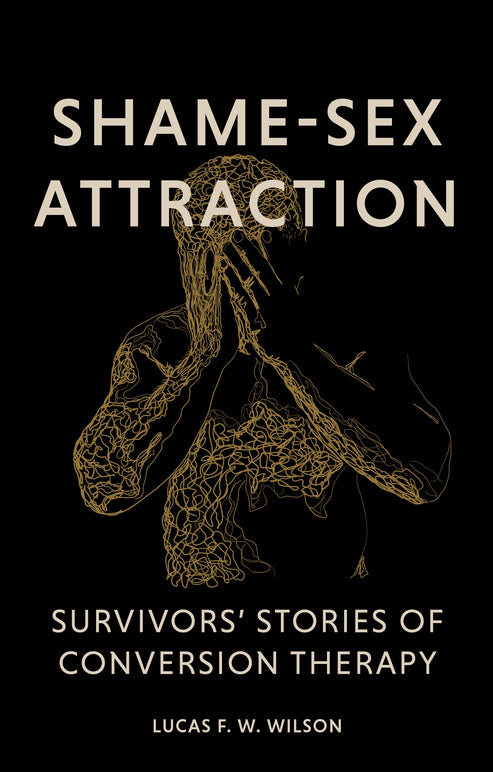
Along comes Lucas Wilson to have compiled a book on the topic which is marvellously well done, and deserving of a place on every bibliography devoted to conversion therapy and other ideologically driven destructive pseudo-treatments:  Shame-Sex Attraction: Survivors' Stories of Conversion Therapy (Jessica Kingsley Publishers, 2025), 192pp. 

I contacted him by e-mail to ask for an interview about the book. Here are his thoughts.

AD: Tell us about your background

LFWW: I grew up in a home with a dad who was an agnostic and a mom who, as I say now, was haunted by her Baptist demons. We were not a Christian family by any means, even if we went to church in the early years of my life. In fact, by grade three or so, my family—like all good Canadian families—went to the cottage rather than church. But when I was just about to enter high school, I became interested in questions of faith, and by the time I was in grade nine, I became a zealous evangelical and remained so for just over ten years (until I deconverted around age 27). When it came time to choose which college I would attend, I chose to study at the world’s largest evangelical college: Liberty University, Jerry Falwell’s school, located in Lynchburg, Virginia. It was there, on campus, that I underwent four years of conversion therapy—that which is now commonly referred to as conversion practices. 

After leaving Liberty, I went on to graduate school and received a proper education. Most of my academic training was in literature, but as time went on, I became increasingly interdisciplinary, working in the fields of religious studies, history, and creative writing. My work has largely centered on the Holocaust, but given the rise in anti-queer and anti-trans violence, public policy, and legislation, I redirected my attention on a main catalyst of homophobia and transphobia today: white Christian nationalism.

AD: Your other recent publications seem to be in the field of Holocaust studies . Tell us a bit about those works and what, if any, connections exist in your mind between them and this new book on so-called conversion therapy.

LFWW: Both the Holocaust and conversion therapy are inextricably connected to Christianity. The Holocaust never would have happened, as it did at least, had it not been for Christianity. Both the Christian scriptures and Christian theology laid the seedbed for the Holocaust—so much of the hatred against Jews that was in circulation before and during (and after) the Shoah was a function of Christian antisemitism. As for conversion therapy, efforts to change individuals’ nonnormative sexualities and genders were enthusiastically supported and promoted by Christians since at least the 1970s; although conversion therapy began in secular contexts, it became something that has occurred disproportionately in conservative Christian contexts. Christianity has played a significant role in both of these sustained attacks on minority groups, and my research on these topics addresses the ways by which Christianity has so easily lent itself to such hatred. 

Of course, there are also many differences between these two areas of research, but despite these differences, my work in these two areas shares a number of theoretical and methodological similarities. Not only do I employ feminist and queer theories of affect, memory, and trauma in almost all my work, but I also approach my research subjects largely by way of oral history, archival collections, and literature. As my approaches to both areas of research overlap significantly, my goal is always the same: to center and amplify marginalized voices in order to better understand underrepresented individuals and groups, especially those in politicized religious contexts.

AD: What led you to write this book in particular on conversion therapy? 

LFWW: I’ve been writing and speaking about conversion therapy for a few years now. Because of this work, in concert with my involvement in the fight against conversion practices in Canada, I was invited by the fabulous Alex DiFrancesco (who became my editor) to edit Shame-Sex Attraction, an anthology of stories about conversion practices as told by survivors themselves. We thought it was important for all the stories in the collection to be written by survivors themselves; representation of conversion therapy has not always centered survivors, and we wanted to make sure that this collection elevated their voices. So, we only included survivors in Shame-Sex Attraction

AD: In your introduction you not only argue that conversion therapies are ineffective, fraudulent, and harmful, but also practices that are motivated by "genocidal intentions."  Some, I expect, might question such language. Can you elaborate on what you meant?

LFWW: This language and argument is original to two rockstar academics whose work I love: Christine M. Robinson and Sue E. Spivey. Though I can’t take credit for this language or argument, I draw upon both Robinson and Spivey’s research in almost all the work I do on conversion therapy, including in the introduction of Shame-Sex Attraction. Put simply, conversion therapists’ desire is for queers not to exist. Indeed, their goal is to eradicate any and all queer and trans representation, vitality, and life. That is, if conversion therapists could have their way, they want to see an end to me, LGBTQ2S+ communities, and queer and trans culture totally and completely. Such a desire is, definitionally, motivated by genocidal intentions. Although some supporters and practitioners of conversion therapy would not want us physically dead—though I am sure many do—genocide does not always aim to physically eliminate people. As has been well-established (especially in regard to Indigenous folks in North America), genocide can also be cultural.

AD: In your introduction especially you give a good overview of the literature on conversion therapies and the awareness of the harms these practices cause, noting that most of the practices still endure today "especially in religious spaces." You hint at some diversity here, but do not go into detail. Are there, to your knowledge, any religious traditions that refuse to engage in conversion treatments or have denounced them?

Yes! There are a number of religious traditions that are not complicit in conversion practices and that actively advocate against the harmful efforts to change queer and trans folx’s sexualities and genders. These are mostly more progressive mainline Christian and Reform Jewish congregations. The sad reality is, however, that many conservative religious traditions continue in their attempts to change queer folx’s genders and sexualities, despite these progressive religious traditions doing the good work they do. 

AD: In looking at national data of those forced to undergo conversion practices, you highlight that "specific minority populations" (p.17) undergo such practices at much higher rates. Any thoughts on why this might be the case?

LFWW: There are a number of complicating factors as to why minority populations are disproportionately targeted. Insofar as many of these folx face increased barriers to education, appropriate healthcare, and other resources, they are more vulnerable to conversion practices. If we think of trans folx specifically, there are numerous challenges they face in regards to receiving proper gender-affirming care. Many trans and nonbinary folx are moreover pushed into conversion therapy in religious contexts because their gender expressions do not allow them to pass; when these individuals were raised in religious families and communities, they were not always able to hide their non-normative genders and were thus more prone to conversion practices. 


AD: You note that "in 1952, homosexuality was listed as a mental illness in the first edition of the...DSM" (p.19). Numerous scholars (Robert Corber, Craig Loftin, Dagmar Herzog, inter alia) have suggested that these clinical decisions were not really driven by science but instead by the politics of the Cold War. What are your thoughts on that?

LFWW: No doubt, there were political factors that shaped the classification of homosexuality as a mental illness in the DSM. There were also social factors like the diffuse cultural homophobia that was in cultural circulation at the time, which made it seem obvious or natural that homosexuality was an illness. But with Alfred Kinsey’s early work in the 1940s, there was already research to suggest that homosexuality was not a mental illness. Shortly after the DSM came out, Kinsey’s next study, along with the work of Evelyn Hooker and others, further refuted this pathologization of homosexuality; however, it was not until 1973 that homosexuality was removed from the DSM. Indeed motivated by political and social politics of the time, this declassification of homosexuality came 21 years too late.

AD: You note that in the 1970s, when "Christian ministries emerged for queer individuals to become straight" (p.20) they were focused on the "transformative power of Jesus" and thus "did not draw on psychological 'explanations' of homosexuality until the 1980s." Have you looked at those programs from the 70s? I'm very curious as to what they consisted of. I'm equally wondering about your thoughts on why they made the turn to psychological explanations in the following decade? What might have motivated that?

LFWW: I have looked at the 1970s programs, albeit only briefly (there has not been an abundance of research on this subject and most of my research has centered on the later aspects of conversion practices). I am familiar with Chris Babits’ work that has focused on Kent Philpott, an early conversion therapist who relied heavily on the curative powers of the Holy Spirit and exorcisms throughout the 1970s. Like Philpott, the early conversion-therapy programs relied heavily upon prayer and faith, and both prayer and faith remained main aspects of conversion practices for many years. 

However, as I explain in the book, by the 1980s they were incorporating so-called psychological explanations for queerness into their teachings. I think the main reason for this was the symbiotic relationship ex-gay ministries and ex-gay “researchers” that the two groups formed. The ministries gained ostensible legitimacy because they had supposed psychological “research” to back up their claims, and the “researchers” (a dubious term to use in regards to these folks) got paid for their books, seminars, and conferences for which the ministries were paying. This is certainly a large reason for what motivated the psychological turn. 

AD: I've edited international scholarly collections and one hallmark is often an enormous diversity in individual chapters, but what I find striking in yours is a certain "uniformity" in that all the chapters resist being tied up in a neat, nice little bow at the end, allowing the reader to go away with a comforting ending. Was that an explicit editorial direction you gave to contributors?

LFWW: This was an explicit editorial direction, yes. I wanted readers to have to sit in the discomfort of what it is like to undergo conversion therapy. Obviously, this is a second-hand discomfort, and most folks (thankfully) will never know the depths of what it was like to be subjected to such dehumanizing practices. However, the endings were to disable readers from feeling some sort of narrative resolution or a sense that all was well for the authors after their time in conversion therapy. I think that we as humans (if I may make such a broad claim about all humanity) desire a sense of resolution when reading or listening to stories and that we often crave a happy ending. The stories’ endings in the collection, as abrupt and unresolved as they are, pointed to how, for survivors, our experiences were quite rough for quite some time. Although we eventually were able to come to terms with what happened to us, for a long time we had really unresolved and difficult times piecing ourselves back together. The stories’ endings gave voice to this, even if indirectly or in a small way. 

AD: The cumulative effect of such abrupt endings is, for me at least, a sharp awareness of the ongoing suffering of those who endured conversion therapies. This, in turn, gives rise to two questions: what do you find people need to recover from conversion "therapies"? Are there common things that many or even most people find helpful?

LFWW: In a Canadian study of conversion practices from a few years ago, that which was most helpful for survivors to recover and come to terms with their experience was friendships with affirming people, followed closely by friendships with 2SLGBTQ+ individuals. In other words, community is wildly important. Of course, therapy is always a good idea (for survivors and non-survivors alike), but not everyone can afford it. However, friendships are free, and a supportive community is of utmost importance to heal. 

AD: You note that your contributors are from North America and Australia, and mostly experienced conversion treatments in Christian contexts. Are there researchers out there you are aware of looking at conversion practices in the global south--Africa especially? (Some churches in Nigeria and Uganda have been especially virulent in their homophobia and promotion of the idea of "converting" from such a "sinful lifestyle".) And are there conversion practices in Islamic and other religious traditions that you know of?

LFWW: Yes, there are researchers who are doing work on conversion practices in the Global South; however, the majority of research focuses on such practices in the West. I think this is a major issue because conversion practices are ubiquitous and happen everywhere. Wherever there is religion, there are conversion practices (including in Muslim contexts). Though I hope the research on conversion practices in the West continues, I am even more eager to see the body of research on conversion practices in the Global South grow—not to mention research specifically on conversion practices in Muslim contexts. 

AD: Sum up your hopes for the book.

LFWW: I would love (and I mean love) for this book to change the minds of conversion practitioners and those who endorse conversion practices—to show them how death-dealing it is to try to change others’ sexualities and genders. I want to show them the immense psychological, emotional, and spiritual harm such practices cause. But I also know that the vast majority of conversion practitioners and their supporters will never read this collection, and even if they did, it would likely not change their minds—these folks do not have the ears to hear or the eyes to see that what they are doing and/or supporting is wrong. As such, I know this desire for them to change their minds after reading this work is a pipedream. 

In either case, I hope that survivors of conversion practices find this book and that they see themselves in its pages. I hope this book offers them solace in that they are part of a group that has persisted despite countless attempts to erase us. And I hope this book reminds them that they are nothing short of beautiful, strong, and resilient—that they are in fact survivors.

AD: Having finished this book, what are you at work on now?

I am currently working on another edited collection, this one about queer experiences at Christian colleges, universities, and seminaries. I am accepting submissions until April 15, so if anyone is interested in submitting a story, I invite them to e-mail me!

The Volkans on Schizophrenia

Nearly a decade ago, I began exploring the underlying psychodynamics of ISIS propaganda, and the wider historiography of the Crusades. In the course of that research, I think it was the historian and psychoanalyst Charles Strozier (in his book  The Fundamentalist Mindset: Psychological Perspectives on Religion, Violence, and History) who first introduced me to the works of Vamik Volkan and his pioneering and pivotal concepts of "chosen trauma" and "chosen glory." 

I went on to read several of Dr Volkan's books, including Bloodlines: From Ethnic Pride To Ethnic Terrorism. These and others of his corpus have been very helpful to me in several articles and lectures, and now in a book I have coming out later this year on the dynamics of Russian-Ukrainian historical and religious conflicts. 

More recently, as readers may recall, I interviewed him about his Large Group Psychology which was published by Phoenix in 2020. (By all means order the books through Phoenix directly where you will often get a discount.)

All this is to say that when I learned last year that Phoenix was publishing a new book he co-wrote with his son Dr Kevin Volkan, and that the book was on schizophrenia, about which I have been reading extensively since last fall, I was very excited and determined that I must read it, as I have now done, and also determined to interview the authors, as they have also now graciously consented to doing. 


Before turning to their thoughts, let me further entice you to order their new book Schizophrenia: Science, Psychoanalysis, and Culture by pointing out just two of its paramount virtues (and leaving you to discover the rest for yourselves): first, there is a consistent and wholly welcome modesty throughout the book. It is sometimes put about by lazy and uninteresting people (who are usually engaged in projective identification) that those of us who operate psychodynamically are hide-bound rigid ideologues rejecting all other forms of psychotherapy, from drugs to CBT to whatever this week's acronym du jour is. But, as you will presently read, while both Volkans (père et fils) are clearly steeped in psychoanalytic thought and approaches, they do not brandish any of that as a means of denigrating or dismissing pharmacotherapies and CBT. Time and again throughout the book one encounters--if you will--the "subjunctive mood" on many occasions. Their language is modest and quite sincerely so: regularly one reads that some people may be helped by some of the treatments examined here, but that no treatment is appropriate for everyone. There is no totalizing language here buttressing sweeping claims!

This is all embedded in a book whose first half looks at contemporary neurological and aetiological research into schizophrenia and acknowledges the use of psychotropics as being helpful, whether as stand-alones or as adjuncts to other therapies. It also examines CBT approaches and recommends some of those where appropriately indicated.

Second, and related to this first virtue, is the extensive attention paid--in the final quarter of the book--to cultural questions about the history, diagnosis, manifestation, and treatment of schizophrenia outside a middle-class American context in the early 21st-century. This too marks the book out as distinct in my (so far limited) experience in the field. 

With that in mind, let us turn to our two very distinguished authors and hear from them. 

AD: Tell us about your backgrounds

Kevin Volkan, EdD, PhD, MPH (KV) is a founding faculty member and Professor of Psychology at California State University Channel Islands. He also currently serves on the Graduate Medical Education faculty for the Community Memorial Hospital System in Ventura, CA, and as an adjunct faculty member for California Lutheran University’s clinical psychology doctorate program. 

Vamık D. Volkan, MD (VDV) is the author, co-author, editor, or co-editor of over fifty psychoanalytic and psychopolitical books. He is an Emeritus Professor of Psychiatry at the University of Virginia, Charlottesville and an Emeritus Training and Supervising Analyst at the Washington Psychoanalytic Institute, Washington, DC. In 1987, Dr Volkan established the Center for the Study of Mind and Human Interaction (CSMHI) at the School of Medicine, University of Virginia. He is the President Emeritus of the International Dialogue Initiative (IDI), which he established in 2007. 

As we say in the foreword of the book, we come from different but overlapping backgrounds. We give a more comprehensive overview of our backgrounds there.

AD: What led you to write this book on schizophrenia now?

VDV: Many individuals with this condition do not get enough or necessary treatment. Many are out there wandering around. It is important to bring attention to this mental/societal condition.

KV: Where I live in Southern California, we have an enormous homelessness problem. This is also true in many other parts of the country. Driving through downtown Los Angeles, it’s hard to believe that this is America. Conservative estimates are that around a third of the homeless population have severe mental illnesses – usually schizophrenia. 

So, although this disorder is a big problem, there has been little progress on how it is understood and treated over the last 50-100 years. The scientific understanding of the biological roots of schizophrenia has made great strides, but this has not yet translated into better treatment and care for people suffering from schizophrenia. 

But there are several new treatment possibilities on the horizon. Some of these new treatment methods include various types of psychotherapies. While psychoanalytic-derived treatments have been around for a while, these have not often been applied to psychotic individuals, especially in the United States. People like my dad have been working with those who suffer from schizophrenia in an in-depth way. He has learned a lot about schizophrenia and has important insights into how psychotherapy can be used to treat it. Our book is an attempt to communicate this insight as well as to document the state of schizophrenia research and treatment as it stands today.

AD: What is it like co-writing a book, especially as father and son?

VDV: One of the best things that ever happened for me. I felt very proud of my son, a great academician.

KV: Working on this book with my dad has been a wonderful experience. I was a bit nervous at first since he is such a luminary in the field. But the writing process went very well and was a chance for us to get to know each other and become closer.

AD: You note (p.19ff.) that cannabis use has been linked in a number of studies going back over a decade to increased rates of and risk for schizophrenia. Tell us a bit about some of those findings and your views on them. Given the increasing popularity and legalization of cannabis in North America, do clinicians need to be extra vigilant in screening for use? Are we as a society proceeding too fast in tolerating or even encouraging recreational use of cannabis?

KV: There are many studies that link the development of schizophrenia and cannabis use. The causal direction of the relationship is not entirely clear. For instance, do people who have a predilection to developing schizophrenia self-medicate with cannabis in a prodromal phase or do they use cannabis which then triggers the onset of psychosis? The latest research suggests that the latter is more likely especially among adolescents. Early age of cannabis use, and frequency of use seem to be predictive of significant risk for developing schizophrenia among vulnerable young people. 

Cannabis has not, as far as I know, been legalized anywhere for adolescents. Will legalization cause in increase in adolescent cannabis use? Maybe, maybe not. We are in the middle of a ‘natural experiment’. Will legalization cause a spike in first episode schizophrenia? A study by Vignault et al. in 2021 in Canada found that cannabis use among adolescents did increase when cannabis was legalized but did not seem to cause an increase in diagnoses of psychotic disorders (interestingly, there was a modest increase in personality disorder diagnoses). So, I think the jury is still out about the relationship of cannabis legalization to schizophrenia.

What I advise my undergraduate students and as well what I tell my clinical psychology graduate students to tell their patients is the following:

  • Early cannabis use is bad. Children and adolescents should not use cannabis period, especially given the increased strength of the drug. 
  • For people in their 20s there is some risk from cannabis use, especially if they are chronic users of strong cannabis. If there is no family history of psychoses and the use is occasional, the risk of developing schizophrenia is not zero, but is low.
  • For people with a first-degree relative diagnosed with schizophrenia or another psychotic-adjacent illness they should not use cannabis at all. This is especially true for kids and young adults. 
  • People who are diagnosed with schizophrenia or a psychosis adjacent illness should not use cannabis.
  • Adults in their 30s -50s who do not have schizophrenia or something similar and who do not have first-degree psychotic relatives are not likely develop schizophrenia because of cannabis use.
  • Adults older may find some cognitive benefit from cannabis use, again provided they do not have a schizophrenia or similar diagnosis.

These recommendations are speculative and subject to change when better research becomes available. (See Vignault, C., Massé, A., Gouron, D., Quintin, J., Asli, K. D., & Semaan, W. [2021]. The potential impact of recreational cannabis legalization on the prevalence of cannabis use disorder and psychotic disorders: A retrospective observational study. The Canadian Journal of Psychiatry / La Revue Canadienne de Psychiatrie, 66, 1069–1076.)

AD: You mention (p.76) that Searles (whom I wrote about here) suggested clinicians treating schizophrenia need to pay attention to the counter-transference. But this theme is not much developed in the rest of the book. Would you want to elaborate some thoughts on that here?

VDV: The psychology of analysts and therapists undertaking intense work with people with schizophrenia needs consideration; for example, their ability “to regress in the service of the other” is crucial. The necessity of tolerance and therapeutic use of countertransference in treating patients with schizophrenia demands that the therapist meet the patient in his or her regressed state and, in a sense, validate it without intruding into the therapeutic space. The patient must feel that he or she is not alone in a strange place. This conduct helps change the patient’s regression from chaotic to therapeutic. Because of their own psychological make-up, certain analysts or therapists may be better equipped than others to use their personal responses to the patient’s primitive activities. Training is important, but most psychoanalytic institutes do not provide the necessary training.

AD: Your 13th chapter on object relations theory was one that I resonate deeply with. There, and in several other places in the book, you speak of schizophrenia patients as "object hungry." Would you elaborate a little bit on that concept for our readers?

VDV: The patient with schizophrenia is hungry for libidinal experiences, but this hunger is never satisfied. An attempt is made to collect "good" images in order to libidinalize the infantile and adult psychotic selves, but the patient also collects "bad" objects under the influence of repetition-compulsion, and certainly in the patients’ experience what is “eaten” as good might easily turn out to be bad.

Utilizing its available ego functions, the infantile psychotic self, like the early computer game character Packman, is doomed to “eat up” anything in front of it, without finding any food that is nourishing. The infantile psychotic self’s main ego function is internalization. 

But it also evacuates constantly what has been “eaten.” Therefore, its other main ego function is externalization. Here I am using the terms internalization and externalization to separate these functions from more sophisticated introjection and projection mechanisms in which there is some fit between what is projected and the target and between what is introjected and the reality of the object before it is taken in. Such fits do not exist in externalizations and internalizations. At times even these primitive ego mechanisms are not functional. The infantile psychotic self simply fuses with objects, only to separate from them.

AD: The number of chapters devoted to cross-cultural understandings of schizophrenia was itself hugely impressive, going far beyond what I've found in numerous other recent works. Why was it important for you to include this material?

KV: While the prevalence rates of schizophrenia are similar around the world, the ways in which it is related to specific cultures varies a lot. The relationship between schizophrenia and how specific cultures deal with the disorder can provide many insights into understanding, preventing, and possibly treating schizophrenia. 

These chapters also point out that there may be different kinds of schizophrenia with some versions having a more ‘physiological’ etiology (qi gong psychosis for example) with other versions deriving more from societal conditions (for instance Saora psychosis). The idea that people in the developing world are less likely to have subsequent psychotic breaks after their first episode has been floating around. This may be related to not being treated with antipsychotic medication on first presentation or may reflect something in the culture which provides some resilience. 

Additionally, there is a lot of research about the increased risk for schizophrenia among immigrants. Switching cultures may undermine cultural resilience in several ways. I am especially interested in cultural variation in early object relations as something that possibly can prevent schizophrenia from developing in people who have a propensity for the disorder.

AD: You note (pp.116-17) that it may be important for psychotherapists treating schizophrenia to have a more fully developed "potential for regression in the service of their patients." Would you elaborate a little bit on this? I'm wondering if it is similar to Harold Searles saying that therapists need to be in touch with their own psychotic elements when trying to treat schizophrenia?

VDV: When I was growing up on the island of Cyprus my paternal grandfather used a plow pulled by animals that thrashed the wheat. “Regression” was not a scary thing for me.

KV: I think we answered a lot of this question in the response to question 6 above. In essence regression allows us to walk with the patient in their experience without our countertransference getting in the way of this. One of my teachers calls this the ability to maintain dual consciousness – a regression into the chaotic unconscious of the patient while simultaneously maintaining a rational egoic consciousness that guides the therapeutic interaction. In my opinion, this requires a certain degree of talent that probably has to do with one’s early experiences. 

I can add that I have been involved with and studied several Asian religious and philosophical systems which include meditation as part of their practice. Most meditation techniques include some form of regression. Because of this experience I have not found working with people who suffer from schizophrenia especially difficult. I agree with my dad that training is important and training specifically to do psychotherapy (not behavioral or case management) with those suffering from schizophrenia doesn’t happen much. In a sense I was fortunate to begin my career working with people suffering from schizophrenia (I wrote a blog piece on this.) I also think that working with people who suffer from personality disorders like borderline personality disorder, etc., where the patient can experience temporary psychotic states, is also helpful in learning to treat schizophrenia. 

AD: I really found your concept of the "doughnut personality" (pp.86-89) insightful. Tell us a bit more about that.

VDV: I will focus on the patients’ descriptions of their changed personality soon after the loss of their existing personality. These patients, at least for a short time, describe a new personality, which I named a “doughnut personality.” My doughnut analogy refers to patients’ experience of an exaggeratedly fearsome or exaggeratedly idealized outer layer, which is the dough of the doughnut, and a middle part that is either perceived as empty or filled with unpalatable “bad” jelly. The patients experience the outer layer as a "monster" or the opposite, an "angel" (or some similar term) according to the degree this component is saturated with the derivatives of aggression or libido.

Several of my patients going into schizophrenia described the two components of a changed personality by comparing them to a doughnut. After a while, the outer component of the dough changes; a sense of extra omnipotence (megalomania) infiltrates the dough. For example, patients now declare that they are Jesus or another prophet, the greatest musician or the best terrorist. This corresponds to classical observations on the development of “world construction fantasies.” But here I am describing a new construction in these patients’ perceived sense of their internal world. When omnipotence settles, their references to the "bad seed" or "emptiness" seem to lessen a great deal or disappear altogether.

AD: Sum up your hopes for the book, and who especially would benefit from reading it.

KV: I’ll just repeat what I said in my blog piece: The book can serve as a textbook for graduate clinical psychology students, psychiatry residents, as well as students in counseling, clinical social work students, psychiatric nurse practitioners, and other mental health graduate programs. The book is also written for the lay reader who seeks to understand more about schizophrenia, as well as the theory and process of psychoanalysis and psychoanalytic-based therapies. 


AD: Having finished this book,
Schizophrenia: Science, Psychoanalysis, and Culture, what do you both have in the pipeline next?

KV: I have been working on a book about demonic possession. This will be a predominately psychoanalytic exploration that will be an expansion of a paper I published recently. I am also working on a paper looking at the latest social cognition research on schizophrenia and its implication for psychoanalysis and psychoanalytic psychotherapies with people suffering from schizophrenia. My dad and I have talked about working on a book on psychoanalytic therapy that is based on work he has done in China, which would be a fun project.

K.R. Smith on Ethics and Psychotherapy

It was, if I recall correctly, Jason Blakely (whom I interviewed here) who put me in touch with Kevin R. Smith, author of two recent books: Therapeutic Ethics in Context and in Dialogue (Routledge, 2020, 108pp) and The Ethical Visions of Psychotherapy (Routledge, 2020), 112pp. I have read both of these books with great profit, and found them much more philosophically enriched and enriching than anything else I have to read currently in the area. I might even be bold enough to say here that clinicians who are only clinicians, that is who have never done any hard work in philosophy, have no business lecturing the rest of us on topics they scarcely understand themselves. Happily, Smith is not like that, coming at these books with a wide-ranging background that shows up in both books to great profit. 

Following my usual practice, I e-mailed him some questions for an interview about these books, and with heroic patience (such a key virtue for clinicians!) he has waited 

AD: Tell us a bit about your background:

KRS: My path is not the standard one for professional psychologists. I was not a psychology major as an undergraduate. While I had some good psychology classes at Berkeley in the early 1970’s, the program was influenced by positivist and behaviorist conceptions of psychology that missed the complexity and richness of human experience. As an alternative to a psychology major I took advantage of the option available at Berkeley to construct an interdisciplinary major that included classes in psychology, other social sciences, and the humanities. 

After a master’s degree in religious studies at the University of California at Santa Barbara, I entered the doctoral program in clinical psychology at Duquesne University. I had been exposed to the work of Ricoeur and Heidegger at Berkeley and Santa Barbara, and was excited to be studying psychology from the perspective of existential phenomenology. This program deepened my appreciation for the implicit philosophical assumptions often present in psychological theories that purport to be based upon objective data alone. 

But finding work where this alternative perspective on psychology was even known, let alone valued, was not easy. I worked in various settings (community mental health, a rehabilitation hospital, and a large psychiatric institution, and research center) where I gained further experience and training before starting my own practice. In retrospect, I’m glad I have had experience in these work settings, where mainstream ways of understanding and practicing therapy and conceptualizing psychopathology were dominant. 

But the sense was always there that something was amiss with the standard approaches. I have been struggling ever since to articulate what seemed wrong, and what the alternative might be. I have had help along the way from fellow therapists who wanted to understand people and their psychological difficulties in depth. Pittsburgh provided me a continued connection to the human science approach to psychology at Duquesne, experience with psychotherapy research at Western Psychiatric Institute and Clinic, and a series of seminars organized by Bill Cornell that exposed me to a variety of perspectives on psychodynamic therapy.

AD: You had me hooked on the first page of The Ethical Visions of Psychotherapy when you wrote this: "Therapy is also a social practice that enacts some perspective on what constitutes a good life, human well-being, or flourishing." And yet you note later on (ch.5) that "therapists rarely allow themselves to use the language of ethics in a full sense. They are often more comfortable with the language of repair." Why does it seem that virtually every school of psychotherapy wants to run from this question of the good, of flourishing--even as it smuggles in such assumptions through the backdoor?

KRS: There are a number of reasons why therapists avoid explicitly acknowledging that they are promoting ideas about the good. One category of reasons has to do with the nature of the goods that therapy promotes. These are often some variant of personal freedom or authenticity that is frequently understood to have its source in the individual. Whether this is viewed as a personal choice of how to live one’s life, or as fidelity to some core, authentic self, it often leads therapists to assume that they ought not to interfere with the patient’s free choice, or that their task is simply to free up an authentic self that has been buried, blocked, or distorted by social constraints and internal defenses. These ideals can often be valuable guides for practice, but therapists are mistaken when they think that there is no vision of a good life on offer here. Autonomous self-direction and authenticity are ethical ideals.

Another category of reasons for reticence about the promotion of some picture of human flourishing in therapy is the history of therapeutic efforts to challenge or undo the damage done by the excesses of conscience. Many people seek out therapy because they feel they are failing at life in some important respect. For some of these people, there is a recognition in therapy that they have been suffering from excessive demands to meet standards for a good life. 

Psychoanalytic ideas about relieving the relentless character of superego demands and rational-emotive therapy’s challenge to the oppressive “oughts” and “musts” under which people labor are both examples of the way that therapy seeks to undo the damage done by alienating expectations of doing well or being good. As a consequence, many therapists are wary about proposing another set of obligations for patients to live up to. Nevertheless, an ethical ideal is still present here, one that emphasizes the need for people to find their own way to live rather than take on what family, church, society, or their therapist have said their aims should be (even as the therapist is here promoting an ideal).

Both these reasons to steer away from open discussion of human flourishing receive support from yet another quarter. This has to do with the effort to give therapy scientific credentials. Often this effort is built upon a conception of science as only giving us information about what is the case, not about how things should be (the “fact-value dichotomy”). To the extent that therapists think of themselves as intervening in disorders or patterns of behavior based upon a scientific understanding of their causes, they can claim that they are simply agents who help to change circumscribed problems, not proponents of a particular set of ideas for how to live well. 

This view of therapy as technical intervention can hide from view the ways that therapy also functions as a social practice that instantiates various ideas about living well. Consider the different ways that psychological disorders are defined. If one compares the Diagnostic and Statistical Manual of Mental Disorders with the Psychodynamic Diagnostic Manual, for example, it is clear that there are different conceptions of the difficulties in living that people bring to therapy, conceptions that imply different ideas about what is important for human well-being. The DSM model implies that disorders are impediments to people getting on with their lives as they have decided to live them--the ideal is some form of autonomous self-direction. The PDM proposes a thicker set of ideals regarding a complex set of capacities for self-reflection, affective attunement, and interpersonal engagement, with autonomous self-direction as only one of many valued characteristics of psychological health. 

AD: You write early on that "the central thread that runs through this book is the philosophy of Charles Taylor." I've been reading Taylor for years, and drew on him in my recent book about the Catholic sex abuse crisis. Tell him why he's important for your work, and what ideas of his you find especially useful.

KRS: Taylor’s philosophical anthropology makes a great deal of sense to me, and helps to highlight many of the dead ends of current conceptions of therapy. A central theme of Taylor’s work on human science is his critique of claims to naturalistic objectivity and ethical neutrality. Insofar as persons are “self-interpreting animals” in Taylor’s sense, it is not possible to understand their actions as the result of objective influences alone. 

People do much of what they do because of how they understand themselves and the dilemmas and difficulties that arise in the effort to live a form of life they aspire to. To aspire to a form of life is to assess what one does and how one lives against a set of standards that one feels called to answer to, it is to be what Taylor calls a “strong evaluator.” 

An enormous range of questions can arise in this context that go far beyond removing obstacles to pursuing a life one has chosen. One can question whether the way one has been living one’s life is basically misguided. Do I hold myself to an impossible standard of perfection? Have I misunderstood what I am aiming for? Why do others keep responding to me as though I were someone different from whom I understand myself to be? Is the life I’ve been trying to live possible for me, truly my own, or an alienating imposition from family or culture? Questions like these are often an essential context for understanding particular psychological problems like panic disorder or depression. The level of discourse in which such questions are framed and addressed cannot be derived from a set of findings about which technical interventions bring about changes in particular symptoms.

Further, it is not just the difficulties that patients struggle with that point to deeply held evaluative assumptions. In the effort to assist people with their difficulties each therapy also promotes a particular take on what is essential to a life well-lived. The role of ethics in therapy is not always acknowledged. Sometimes the failure to acknowledge an implicit ethic is based upon therapists’ assumptions that their ideas about well-being are so basic or universal that there is no need to justify or reflect upon them. 

It is here that Taylor’s work on the modern identity in Sources of the Self, The Ethics of Authenticity, and A Secular Age is enormously helpful. In identifying the particular socio-cultural context for many of the modern ideas about human flourishing that are evident in the psychotherapies Taylor provides a platform from which to begin see that ideals like authenticity, interpersonal intimacy, rational self-mastery, or liberation from social constraints are not universally desired components of a good life.

AD: You note the importance of examining "ethics" in the eyes of psychology and psychotherapy and all the assumptions therein--as well as what is missing. You note that every form of therapy has some implicit ethical or moral notions: CBT people implicitly value what they call rationality (to which I'm always wanting to retort with MacIntyre's famous question: Whose Justice? Which Rationality?); psychoanalysts place great store on freedom; and of course everybody, including mainstream medicine, stresses "patient autonomy." Why is it important to call these out and examine them? What happens, in other words, if we continue to leave these notions of rationality and freedom unexamined?

KRS: To see that various assumptions about living well only make sense in socio-cultural context makes it possible to begin to question those assumptions. This is important, even if at the end of this questioning a decision is made to re-affirm those views, now not as unquestioned assumptions but as having some situated rationale. For example, it is not difficult to locate different therapies in relation to Taylor’s exploration of two distinct versions of the modern “inward turn.” 

There are traces in contemporary therapy of both the stance of rational, disengaged reflection descending from Descartes and Locke and the more immersive self-exploration running from Montaigne through Rousseau and the Romantics. As Taylor spells out the history of these two forms of modern inwardness he also points to the ethical rationales that have been given in support of them. In Taylor’s view, neither of these has definitively won the day nor proven the other to be simply mistaken. The differences between them are not such that there is likely to be a resounding defeat of one by the other, even if mutual critique is illuminating.

The situation is similar with regard to the therapeutic orientations that derive from them. Failing to consider the fundamental ethical differences between different therapies leads to the mistaken idea that one type of therapy can be vindicated by simple empirical evidence regarding a narrowly defined efficacy at symptom reduction. But it also leads to avoidance of the richer ethical language necessary to grapple with what is at stake between the therapies. Moreover, any particular view of what it means to live well can have an enormous range of variations, even within one therapeutic orientation (consider the variations between the different schools of psychoanalysis). Autonomy, authenticity, liberation, and rationality can all come in many forms that deserve careful examination.

AD: You note at one point something that has long bugged me: The very idea of finding more "efficient" means of therapy contains within it a conception of the good life. And then Ch.5 opens with: "If one type of therapy works better than another, why should we care about its underlying view of flourishing?" Tell us a bit more about your thinking here about issues of efficiency and efficacy, and why it is important to analyze such seemingly unobjectionable ideas while also taking account of human flourishing?

KRS: The emphasis upon efficacy and efficiency in many discussions of therapy can introduce one notion of living well that deserves consideration, but it cannot simply be assumed to be definitive. There are nested domains in which this language appears. The most common one is the call for efficient and effective therapy, that is, for therapy whose value is measured in terms of how well, how quickly, or sometimes, how lastingly, it reduces concrete measures of disorder, like symptoms, self-report measures of distress, or associated measures of functioning, life satisfaction, etc. At a “meta-level” are arguments to develop methods to effectively disseminate these effective therapies, that is, to effectively and efficiently train therapists to do these therapies. 

Fundamental to all of this is a sort of utilitarian ethic that attempts to develop a sort of calculus of suffering and scientifically founded methods to reduce that suffering. There clearly can be value in this project. It has motivated the development of therapies that have benefited many people. Reducing the fear about and frequency of panic attacks or decreasing suicidal ideation are not trivial improvements in people’s lives. 

But to think about the benefits of therapy only in these terms is to ignore other ways of thinking about how therapy helps people to live well. It is simply not a forgone conclusion that therapy is the removal of impediments to living whatever life people want to live. For many, their psychological problems point to something amiss in their reigning assumptions about a good life, assumptions that are now open for re-examination. One risk of a focus on effective removal of symptoms is that it can imply: “Get rid of your symptoms, then exercise your free agency to choose whatever form of life you like. After all, there can be no real answer as to what makes for a good life. It’s simply a matter of personal preference.” What is suggested here is that what really matters is an unencumbered freedom to choose. That is the ultimate good. But that leaves no reason for one’s choice, for there is no good outside of my preferences that I answer to, or that can give some confidence or grounding to my choice. 

AD: If I was cheering earlier, I was on my feet for a standing ovation when you recognized that "the evidence to warrant the designation 'empirically supported therapy' is far weaker than is routinely claimed, especially for the short-term manualized therapies." Apart from Jonathan Shedler's invaluable work, yours is one of the only other voices I've come across recently calling out the dangers of excessive deference to that talismanic phrase "evidence-based," which tendentiously smuggles in all sorts of ideological assumptions hidden under philosophical naiveté. Tell us a bit more about the problems and assumptions built into claims to be "evidence-based."

KRS: It is certainly reasonable to ask if a therapy does any good. But the usual criteria for a treatment to be considered evidence-based are a truncated form of this question. The appeal of this way of assessing therapy is that it lends itself to empirical evaluation. The results are not always impressive. Shedler and other researchers have noted that the measurable symptomatic improvements of the short term therapies are often small and temporary. 

Further, different types of therapy can achieve similar results according to standard measures of symptom reduction. The question then arises as to whether different therapies might offer different benefits beyond symptom change. One danger of the evidence-based practice movement is that it implies the irrelevance of questions about the relative value of a broad range of goods or benefits that may be on offer in therapy. 

To use a simple example, if both Dialectical Behavior Therapy and mentalization-based psychodynamic treatment have some success in measurable outcomes in the treatment of borderline personality disorder, how do we assess the relative value of the dialectic of self-acceptance and change that is part of DBT against gains in mentalization?  There is something internal to these distinct therapies, something that is part of their particular views about what matters most for living well that deserves consideration on its own merits, not just in terms of symptomatic improvement. As an analogy, suppose one were to decide whether to be a Presbyterian, an Episcopalian, a secular humanist, or a Marxist based upon research showing that the members of one of these groups had statistically higher measures of  self-reported happiness, or higher levels of functioning.  To choose one form of life over another upon such bases is to ignore the distinct views of the good internal to each. 

Therapies designed and tested against the criteria to be evidence-based may well provide significant benefits. But the talisman of “evidence-based” can obscure a number of other important considerations about the value of therapy.

AD: At one point after comparing DBT and psychodynamic approaches to treating borderline personality disorder, you note that "common factors are operative across technique and problem. They do not subsume and dissolve all specifics into one common therapy for all disorders." This leads me to a worry I have about those calling for psychotherapy integration, not unlike appeals for "Americans to come together" after the election: what notions--potentially problematic and objectionable notions--of the good life are being smuggled in behind these appeals to unity and integration?

KRS: Efforts to bridge the differences between the therapies by integrating different components of practice or theory are not necessarily misguided. It can be part of a laudable effort to develop therapy in new directions, and can lower the temperature of debates between competing schools. 

But there are dangers. Under the guise of integration, one perspective can be subsumed within another, with the loss of what is distinctive about what has been subsumed. The aim should not be to move the many schools and sub-schools of therapy to a unified theory and practice, but to engage in a more vigorous debate about the competing aims of the therapies. There is value in respectful engagement with the diversity of approaches. Dialogue here includes debate and critique—agreement may not be the outcome. But at least with regard to the debates between different schools of therapy there should be some protection of the right for all to be part of the debate. This is far more valuable than unity.

AD: At the end of ch. 5 I felt very much called to account when you write that "adherence to favored therapeutic orientations is influenced by the appeal of the particular picture of flourishing, of how to live life well and fully." This very much undergirds my continuing allegiance (but not uncritical, or unappreciative of other approaches) to psychoanalysis and its picture of flourishing as freedom which disrupts various forms of repression--individual and social alike (as we see in a recent book A People’s History of Psychoanalysis: From Freud to Liberation Psychology by Daniel José Gaztambide, whom I interviewed here). Is part of your argument that therapists need to be more open about their adherence, and more willing to subject it to searching examination to analyze underlying moral claims?

KRS: Absolutely! Adherence to a particular approach to therapy often has complicated sources: experience with being a patient or therapist in a particular therapy, or the way that a particular therapy matches one’s intellectual or cultural assumptions and style. And there’s nothing wrong with therapists finding a home in one school rather than another, even if that means they are limited in what they have to offer patients. None of us can be all things to all people. But it is problematic to let the justifications for a favored approach lead to definitive conclusions or institutionally enforced policies regarding which therapies are legitimate. Therapists’ reflection upon and debate with others about their underlying moral claims can not only protect against hubris--it may also help them to amend or even fortify their ethical assumptions. 

AD: If that's the case, then I'm wondering whether training programs do not need a whole lot more serious philosophy courses built into them, so that "ethics" is no longer a single course telling prospective therapists what their professional association's code forbids and requires, but instead gives them a level of facility and insight so that philosophical debates about human flourishing can be much richer than they are now?

KRS: I would love to see greater discussion of these issues within training programs. Unfortunately, ethics is often presented in training programs simply in terms of how not to avoid missteps in one’s professional duties. As valuable as those considerations are, they overlook important questions. For example, the American Psychological Association’s code of ethics promotes fundamental principles of beneficence and nonmaleficence, principles which enjoin therapists to offer something of benefit and to avoid doing harm. But if the benefits are understood only in terms of standard ideas about effective treatment a wide range of fundamental ethical questions are overlooked, or worse, they are assumed to already be definitively answered.

AD: Sum up your hopes for the books and who especially would benefit from reading them.

KRS: I hope that these questions get a wider hearing, and certainly there are others who are raising them, like Philip Cushman, Frank Richardson, Blaine Fowers, Brent Slife, Donnel Stern, Donna Orange, Robert Stolorow and others. 

But the culture of therapy, which is shaped by the larger culture of modernity, has certain built-in impediments to recognizing the salience of these questions, so I think the effort to gain recognition for them will be an uphill battle for some time to come.


My hope is that the books would have a readership beyond those who are already interested in philosophical questions about therapy. I think any therapist, regardless of theoretical orientation or stage of career, can have questions from time to time about more fundamental issues about therapy, about what it is, what its fundamental aims are, what good it might do, what therapeutic aims are most worth pursuing, and why. I hope that these books provide some specificity to and justification for asking such questions. I have tried to be respectful to therapeutic orientations other than my own because I do respect them, but also because I want to encourage therapists across the spectrum of different schools to consider these more fundamental questions.

AD: Having finished both books, what projects are you at work on now?

KRS: I’m currently working on a paper for a special issue of International Journal of Philosophical Studies dedicated to Taylor’s legacy and possible future impact. I am also working with a group of analytically oriented psychotherapists in Pittsburgh to develop a new program for education in psychoanalytic psychotherapy, the Western Pennsylvania Community for Psychoanalytic Studies.

On the Radical History of Psychoanalytic Liberation: An Interview with Daniel José Gaztambide

To immerse yourself, as I did over the Christmas break, in Daniel José Gaztambide's new book, A People's History of Psychoanalysis: from Freud to Liberation Psychology is a thrilling experience indeed. It is a deeply fascinating book uncovering all sorts of links and connections, possibilities and prospects, some realized, some thwarted, some both. Above all, I walked away with a rejuvenated sense that the original psychoanalytical movement was indeed much more socially radical in its vision and hopes than many of its successor personages and institutions were and are, with their turgid, hide-bound bourgeois orthodoxies that have made so much of psychoanalysis and psychology alike the preserve of respectable middle-class white people. I also found a kindred spirit in the author who ranges clearly and comfortably over the borderlands between psychoanalysis and theology, seeing in both a vision of social liberation far more radical than reactionary apologists for both disciplines often realize. 

I contacted the author by e-mail about his book, and here are his thoughts:

AD: Tell us a bit about your background

DJG: I’m originally from San Juan, Puerto Rico, born and raised in the Hato Rey sector of the metro area. My father is a “Brown” Puerto Rican man, and my mother was a White Cuban refugee from the Cuban Revolution. They were both heavily involved in our church community, Un Ministerio Sanador por Una Iglesia Sanadora, “A Healing Ministry by a Healing Church,” where my mother worked closely with our pastors. Our church, which had a orientation of healing and restoration toward the community, was very psychologically minded. 

My mother would read me books on psychoanalytic diagnosis, including from a theological perspective. Although she barely had a middle school education, she, along with my pastors, were the first to introduce me to psychoanalysis. I bring that up because one of the first things I encountered when I came stateside was this strange idea that psychoanalysis, in its essence, was too “Western,” classist, racist, sexist, and culturally incongruent with the worldviews of global south and colonized peoples. Not so under the mango tree of my childhood, the roof of my church, or the care of my community. Psyche, per Freud’s use of the work seele, was the soul if not it’s expression. 

But aside from being introduced to psychoanalysis at an early age, was the function of psychoanalysis—to put the unspeakable into words. And there were many things that were unspeakable in Puerto Rico, because de eso no se habla, “we don’t speak about it.” And the Puerto Rican was wrapped in many silences—around race and the meaning of my father’s Brown body and my White body, around class and the brutal inequality of the colony, around sexuality and the invisibility of women’s sexuality, and LGBTQ people as human. How is it, for example, that Puerto Ricans are “three harmoniously integrated races” yet Blackness is perpetually erased? Putting those questions and unspoken realities into words, in the clinic and the streets, are the impetus of my work. In some ways, my existence.

AD: What led to the writing of A People's History of Psychoanalysis: from Freud to Liberation Psychology?

DJG: The first seeds of this work started in my time at Union Theological Seminary in NYC. I was in the Masters program, which was an academic as opposed to a ministry-oriented degree, studying the intersections of psychoanalysis and liberation theology and psychology. I had been introduced to Paulo Freire’s work, the Brazilian educator and contributor to critical pedagogy and one of the inspirations behind Ignacio Martin-Baro’s book, Liberation Psychology, and was in the seminar library trying to find Jessica Benjamin’s book Bonds of Love. I had noticed all of these parallels around intersubjectivity, the teacher/student and therapist/patient relationship, and social justice, and thought that might be the beginnings of a project integrating psychoanalysis and Liberation Psychology.

I literally stumbled over a stool! And that stumbling brought me eye level with a copy of Elizabeth Danto’s Freud's Free Clinics: Psychoanalysis and Social Justice 1918-1938, Reading that work along with Sander Gilman, and realizing that the first generation of psychoanalysis was predominantly left-oriented Jews marginalized as racial others within the turn-of-century European world, blew my mind. Maybe, I thought, there were more than parallels between psychoanalysis and Liberation Psychology.

Later, when I was a doctoral student in clinical psychology at Rutgers, I was connected to Dr. Danto via an adjunct lecturer and later professor at the Silberman School of Social Work at Hunter College. She was my supervisor there, so I had an opportunity to explore these themes in-depth as I was beginning to write the papers that would inspire the book. It was liberating in a way, to find a story of Freud not at this impenetrable “guru,” a bastion of White male European enlightenment, but as a man negotiating the complexities of race, class, gender, and sexuality—as a matter of survival.

As I was reading about Freud’s cultural context, I discovered a number of contemporaries of both Freire and Erich Fromm who noted the ongoing dialogues between the two of them. Freire’s and others’ account of how Ivan Illich connected Freire and Fromm in Mexico City was powerful to me. In particular the moment when Fromm remarks that Freire’s critical pedagogy was essentially a historical-socio-cultural psychoanalysis. Noting Freire’s repeating citation of Fromm’s books was striking, as it was the first suggest that, actually, psychoanalysis and Liberation Psychology did not just have certain parallels. One actually flowed into and gave roots to the other. Learning how Fromm had originally studied with Otto Fenichel, another leftist psychoanalyst from the second generation who wrote quite cogently about race and class, became the first tributary connecting Liberation Psychology to psychoanalysis. First of many others.

Once, I was sitting with Doris Chang, a mentor and colleague who is more Cognitive-Behavioral, for lunch. As I was sharing all these connections I was discovering she got excited telling me that “It sounds like you’re writing a people’s history of psychoanalysis!” A la Howard Zinn. That was the “aha” moment. The rest, pun intended, is history.

AD: I loved your passage from Freire about how it is not a matter of thinking for the oppressed, but with them. (pp.xxviii-xxix). And yet how quickly did much of psychoanalysis in this country especially seem to revert to a model of "doctor knows best," setting up the kind of over-under relationship between analyst and analysand. This, as you show, was especially contrary to what Ferenczi in particular was attempting. Tell us a bit about his contributions to a psychotherapy of the people, and why that seems to have had a hard time taking root in the USA.

DJG: Ah, this gets at the other tributaries flowing from psychoanalysis to Liberation Psychology! One of the things Fromm did, both prior to and after his coming to America and then Mexico, was read and aggressively defend Ferenczi against the character assassination that took place after his and Freud’s death.

Let me make a few general comments—Freud and Ferenczi, both in their personal correspondence and their writing, talked very openly and cogently about race and class. People often write about how Freud dissociated himself from Jewishness, especially in bringing up race in his writings. That is not true. The story is much more complicated and tragic than that. Freud and Ferenczi were very aware of their Jewishness in an anti-Semitic world, and very aware of how anti-Semitism intersected with anti-Blackness and capitalist exploitation—dynamics which found their way into psychoanalytic theory. 

Ferenczi’s first writings on introspection and internalization were not primarily about parental object-relations, but about the internalization of social class. In particular, the sense of guilt that accompanies “moving up” in the world, and the precarity that even the position you now reached can be easily lost, tumbling you back down to “the bottom.” Similarly, some scholars note that Freud did not interact with any Black people on his infamous visit to the U.S. And yet, Ferenczi and Freud wrote to each other—Do you notice how they treat Black people in America the way they treat us Jews in Europe? How can that be, if they didn’t interact with, or see any African-Americans during their stay? 

If we understand that what is fundamental to anti-Blackness is not only the projection of aggression and animality, but the erasure of Black people’s humanity—especially the capacity to have a mind—then the analogy they drew is obvious. As if to say, “Do you see how Black people are erased in America, the way that we Jews are erased in Europe?”

Freud and Ferenczi shared a theory of how society becomes internalized within the individual, and how those who are framed as enemies of society—working class gentile Whites, for example—can be turned into the very vehicles of society’s violence. How they theorized the internalization of oppression is key and foundation, including to Liberation Psychology. When these dynamics entered the analytic session, that is where they began to part.

Ferenczi considered the possibility that he, no matter how warm or empathic as an analyst, could eventually “commit an act of murder” toward the patient that enacted their original trauma. Thus, he inaugurated a whole new way of thinking in which the analyst is not just a passive recipient of parental, cultural, or societal projections, but an active participant with them. If the analyst could be open to the patient, and think through this repetition not for them, but with them, and take ownership of their contribution, then a real sense of trust could develop--specifically, a trust in the analyst’s mind. 

Fromm, in reading and learning from Ferenczi, was one source transmitting this very same ethic to Freire, who more fully expanded on how this process was not only healing, but emancipatory, bringing the social world itself into view. After all, Ferenczi wrote to Freud on how in their analyses they discover the real conditions of society, as they are mirrored in the individual.

This idea, that the analyst could be vulnerable and open up their mind to the patient, was anathema to Freud. Although we know he was capable of being very warm and caring toward his patients, he was allergic to the thought of real vulnerability with them. We know, for example, that he found patients’ maternal transference to him to be disorganizing. Freud, a caring mother? Perish the thought! This belied an ambivalence toward vulnerability, but everything else associated with it in the social unconscious—femininity, homosexuality, Jewishness and Blackness.

Ferenczi, and Lacan himself recognized this to an extent, representing the best of what psychoanalysis could be—a process of open exploration where the patient, perhaps for the first time, could interrogate their relationship to the Other including the analyst, and discover new limits within which their freedom could be actualized. Not freedom in the sense of “liberty,” or participation in the market, but the freedom to choose in a new way. Freud, Ferenczi, and Lacan exemplify this ethic at different points—Thou art that. 

America wasn’t having any of that! The refrain from American analysts was always, yeah, but aren’t we supposed to educate the client? Give them a new moral framework? Make them good citizens of society? No, said Freud, Ferenczi, and Lacan. Not if that means imposing the analyst’s will as a vehicle for the will of society. They would have been in agreement, I think, with Martin Luther King’s address to the American Psychological Association. Not adjustment to an unequal society that pathologizes “maladjustment,” but the pursuit of “creative maladjustment” should be the north star of our field.

In brief, the ego psychological turn toward adaptation to an “average expectable environment,” the destruction of the psychoanalytic left and trauma of the Holocaust, the pressure in American medicine at the time toward assimilation to Whiteness, and the “Red Scare” all created conditions that turned Freud’s ambivalence toward Whiteness and Blackness into a disciplinary boundary. American psychoanalysis became White. Whiteness and toxic forms of masculinity, as ideologies that stress invulnerability, perfection, and autonomy, do not mesh well with a psychoanalytic stance that stresses vulnerability, humility, and our fundamental connectedness to each other, and the Other’s desire. 

In that sense, Freud and Ferenczi died twice.

AD: The 1918 Budapest congress is, you show in detail, a pivotal moment in the move of psychoanalysis out "into the streets" as it were. Tell us a bit about those developments at and after the congress.

DJG: Absolutely critical. There were a number of intersecting issues here. One was the aftermath of the First World War, and the exigencies of social democracy in rebuilding devastated economies and communities. The other was the proliferation of technical approaches to psychoanalysis, adapting treatment to working with war veterans and multiply traumatized working people. In essence, the war pushed psychoanalysis to define and re-define itself.

On the one hand you had folks like Ernst Simmel, who used “cathartic” technique in ways reminiscent of contemporary exposure therapy, and Ferenczi who, under Freud’s supervision, employed techniques we would today recognize as behavioral activation, exposure and response prevention. Both found that far from “corrupting” the psychoanalytic process, such “active” interventions—active not because the analyst was active, but because the patient engaged in new activity—freed up unconscious material that could be processed in the transference. Freud himself recognized you could only talk about a phobia for so long. Eventually, the resistance against approaching the phobia needed to be addressed--often through what was essentially “homework.”

This conference blew the doors open on a whole new world of technical experimentation which included brief psychotherapy. Also on Freud’s mind was how social democratic states could support psychoanalytic treatment to make it accessible for all. His “psychotherapy for the people,” can be read a “psychotherapy for all.” Public policy, clinical technique, theory, and social justice intersected in fascinating ways in Freud’s speech. Much of this innovation, however, was functionally destroyed by the “Aryanization” of the psychoanalytic free clinics, the Americanization of psychoanalysis—White supremacy on both sides of the Atlantic—and Freud and the other early analysts attempts at survival. In the end, Freud and others chose to “Whitewash” psychoanalysis, betraying the spirit of the theories they had developed, while enacting the very problems they were trying to solve.

Psychoanalysis went from a discourse that challenged social oppression, into becoming its vehicle.

AD: I have several beloved colleagues who describe themselves as Adlerians, and I have always understood Adler to have been much more focused on socioeconomic questions than those in Freud's early circles were often said to be. Yet he is absent in your narrative, as are Melanie Klein (echoes of whom I hear on p.153 in your treatment of splitting objects) and most of the British object-relations and "Middle" schools. Have your researches come across any significant contributions by Adler and British-based analysts to a liberation psychology?

DJG: To be clear—there’s no question about many other veins, tributaries, and roots connecting psychoanalysis to a social justice perspective. That would not only include Adlerians, but also Black psychoanalysts in America who developed new and revolutionary ways of thinking about race, psychoanalysis, and social justice--for example, Margaret Lawrence, one of the first African-American women to graduate from Columbia Psychoanalytic as an analyst. My project with this book focused on the "connective tissue," in both people and ideas, connecting psychoanalysis and Liberation Psychology, from Freud to Martin-Baro. Another project might explore other tributaries connecting psychoanalysis and social justice, whether they touch on Liberation Psychology or not.

This doesn't mean that Adler, Winnicott, A. Freud, or Klein aren't incredibly useful for thinking about these issues, only that they were not the focus of this book. There is some writing, for example, connecting Winnicott and Anna Freud's work in particular with the welfare state during and after WWII. Winnicott's discussion deprivation and delinquency, A. Freud's exploration of defenses, both took place in a context when British children were being literally deprived and their defenses literally bombed by the Nazis.

On the one hand, the theoretical constructs are incredibly relevant--not just parents but societies should provide a facilitating, "holding" environment. However, what Winnicott, A. Freud, Klein, or Fairbairn for that matter did not elucidate is how the broader societal environment, war or not, is not facilitating or holding for working class, immigrant, or ethnic minority populations. One's holding environment can be built upon another's depriving environment.

Neil Altman, for example, has drawn on Kleinian theories of the paranoid-schizoid position to talk about race, class, and splitting. James W. Jones has used Fairbairn and Winnicott to talk about transformative versus oppressive forms of religion.

AD: Your reading of Future of an Illusion brings out, as you say, a "complex, nuanced, proto-postcolonial psychoanalysis of oppressor and oppressed" (p.73) and thus begins laying the groundwork for a liberation psychology. This is not a reading of Future I have anywhere encountered before. Tell us how you came to it, and whether Freud's reputed hostility to "religion" made it more difficult for people to appreciate his liberating potential?

DJG: I've probably read Future of an Illusion ten times throughout undergrad, Masters, Doctoral school, and beyond! There's a bit of a game of telephone at play here--if the general consensus is that this is Freud's "religion book," and that the singular thesis is "religion is an illusion," you can wear that consensus as a lens and find that book and that thesis. But once I had made Freire, Fanon, and Martin-Baro a steady part of my literary diet, and being exposed to Danto's very different take on Freud and psychoanalysis, it's almost like I read Future of an Illusion for the first time. 

Once you read, for example, that for Freud society includes "control the forces of nature and extract its wealth for the satisfaction of human needs, and, on the other hand, all the regulations necessary in order to adjust the relations of men to one another and especially the distribution of the available wealth" (p. 6), that these two functions are interrelated, that "an individual man can himself come to function as wealth in relation to another one," that institutions "aim not only at effecting a certain distribution of wealth but at maintaining that distribution" (p. 7) you simply can't unread that! 

If, as Marx said, the "critique of religion is the beginning of critique," and that the critique of religion leads to the critique of ideology, then Freud is in good company here. My fantasy is Freud might have read Marx and not credited him! This is what is at stake in talking about religion.

To your point--most psychoanalytic critiques of Freud on religion have not picked up on the relationship he draws between religion, race, and the ideological apparatus that protects capitalism. Freud essentially is saying, "Religion is an illusion that fixes our desire on another world in heaven, in exchange for our exploitation. Maybe we don't need oppression and can create the Kingdom of God on Earth." The response, essentially, has been, "Yeah, but good religion gives us meaning, helps us get in touch with primary process and beta elements, access transitional space, have a corrective experience with a benevolent God," etc, etc.

It's not, mind you, that religion doesn't do those things. It's that the critique is almost never placed in the context of political economy--save of course, works like Carrette's Religion and Critical Psychology: Religious Experience in the Knowledge Economy. What would it be like for the psychoanalytic study of religion to "return to Freud" not only as a critique of patriarchal, idolatrous religion (per Jonte-Pace and Jones's great works), but as a specifically White and capital-informed idolatrous form of religion? Freud is clear on this--he's critiquing religion, but specifically White Christian Civilization, and how it upholds the political economy. 

In that sense, it's less about Freud's hostility to religion, and more about the desire to recuperate religion as a technology of self-actualization, which fits within a capitalist, White Supremacist mode of production. Freud and the Liberation Theologians would, interestingly, agree--this form of religion promises us mana in heaven, rugged individualism on earth, and "socialism" for the pharaohs, pharisees, and caesars of the world.

AD: Towards the end of ch.4 you note the ambivalence of Freud's legacy and recognize that while anti-Semitism and anti-Marxism blunted and destroyed the more "radical" inclinations to social justice, Freud himself also undermined the liberating program of psychoanalysis by reverting to being (in Fromm's view, as you show, which I think correct) an authoritarian figure demanding loyalty and subservient disciples. As a result, the tradition has both "emancipatory possibilities and bourgeois anti-Blackness." Tell us a bit more about that latter reality in light of "black psychoanalysis from Harlem to Algeria," the subject of your fourth chapter.

DJG: Absolutely. I think Claudia Tate's classic "Freud and his negro: Psychoanalysis as ally and enemy to African Americans" was really instrumental to my thinking here. She talks about a racist joke Freud would often repeat, "12 o'clock and no negro," referring to one of his American patients. With this joke, Tate argued, Freud evoked the anxiety provoking associations between Jewishness and Blackness on the one hand, and their contradistinction with Whiteness as the standard of the human. He evokes the association, in order to then cut it, finally collapsing it into the antagonism of Black and White. In so doing, he performatively assimilated Jewishness into Whiteness. The joke was a portable "Ellis Island" through which he could become White. 

Psychoanalysis in many respects is a theory about such transformations and displacements. While Jewishness could become Whiteness, this required Blackness to remain the fundamental antagonism facilitating this becoming as such. Blackness, in Freud, was as much a metaphor for the Unconscious, the uncanny double, and primitivity. If the work of analysis is to make the "unconscious," the "unheimlich," conscious and heimlich, and if, as Annie Lee Jones has recently written, Freud considered the preconscious between both as akin to a mischling, or mixed, "half-breed" race, then the traumatic project of at least one form of analysis becomes obvious. 

What Fenichel, Ferenczi, and others began to realize--and I think Freud began to approximate this in Moses and Monotheism--is that the call of Whiteness, "turn White or disappear," need not be the only way. What does psychoanalysis entail when you are the abject defined as non-Human, cast into a "zone of non-Being" that makes being for others possible? 

This is what Fanon wrestled with in his critique and use of psychoanalysis.  For Fanon, ultimately, to make conscious the very desire to make the Black subject become White, insofar as this betrayed a different formula, "turn White and disappear." To look beyond two options which are equally unattainable, to weep between "nothingness and infinity," means to take a leap. A leap into the abyss. A leap without faith or the possibility of arrival. A leap, which, by its radical vulnerability, introduces "invention into existence."

To put it succinctly, what becomes emancipatory about psychoanalysis for Fanon is that it leads us to question the contingencies that rule over our lives. "If you become White, then you will live," and "If you remain Black/Brown/Jewish, then you will die." But the psychoanalytic lens leads Fanon to notice that the Black subject is bound within an "omnipresent death," which renders such "If/Then" contingencies absolutely barren. Whether you become White or not, you are always already not-Human. If there is no "If/Then," then the only term that matters is "I," as in "I want," "I love," "I am," irrespective of the outcome. 

Black Theology, and here I'm thinking of James Cones' The Cross and the Lynching Tree, captures this ethic. Jesus on the cross does not look up at God, wink, and say, "We got this. I know this is part of the plan." No. Instead he says: "My God, my God, why have you forsaken me?" which gives way to a final act of surrender, "Into your arms I commend my spirit." Jesus dies. He is pierced on the side, even though he is already dead. And though dead, rose on the third day. No matter the heavy hand of empire, no matter its brutality and erasure, death has no hold over us. And why did Jesus endure that pain? Because he loved, irrespective of the outcome. 

When you're existence is a perpetual twilight, to demand that one "hopes" for tomorrow becomes an act of violence. The Fanonian ethic, psychoanalytically inflected, simply wants tomorrow, fights for it, demands it, takes a leap for it, regardless of whether it arrives. That is a level of vulnerability Freud flirted with and shied away from. A vulnerability that got Ferenczi buried. A vulnerability that made love not an assurance, but a possibility, for Fanon.

AD: David Pavón-Cuéllar's Marxism and Psychoanalysis: In or Against Psychology is rather scathing in its view that much, perhaps most, of American psychology has hopelessly sold out any interest in social justice to become a totally bourgeois institution concerned with protecting its own power and prestige. Do you see figures in American psychology today who would not be guilty of such a thing, who would be, in your terms, active in or at least supportive of liberation psychology?

DJG: Yes and no. On the one hand, there are those who truly take a consistently decolonial perspective in their work. On the other, to put it bluntly, are those who simply want a more diverse elite. Let me be clear--this not about people being perfect, or some unreachable notion of ideological purity. 

There is a very dangerous alliance between a White liberal desire for a performance of diversity and social justice, and a very specific, professional-managerial group of people from marginalized backgrounds who use that desire to climb up institutional structures, and then kick the ladder behind them. To paraphrase the late activist and podcaster Michael Brooks, a world in which White liberals can simply say "I acknowledge my privilege, now can I keep my money?" is a world that leaves rampant inequality virtually untouched.

The answer, of course, isn't just more ladders, but seriously questioning and deconstructing--here I mean literally tearing down--structures of power. 

If the best possible world we can imagine is one in which Puerto Rico is still a colony under the U.S. in which those Puerto Ricans who are wealthy and White--or can pass, or are light enough--can have, but the overwhelming majority have-not, with egregiously high levels of unemployment and underemployment, poverty, community violence, food insecurity, ecological precarity, and so on, but hey, here's Daniel Gaztambide. He made it, and so can you if you work hard enough and have resilience, optimism, and grit! The silent signifier here is, of course, and if you didn't make it, what's wrong with you? 

That is an extremely dystopian and fatalistic reality. We don't have to jockey with one another for position and status. When we do, the only ones who suffer are ourselves and our communities. When we are divided in this way, our mind shuts down, focused on the question of "Who am I?" and "Where am I in the hierarchy?" It would be great if the outcome was the realization that the hierarchy itself is itself. But more often than not, we become obsessed with climbing the very hierarchy that hurts us. No sense of solidarity is possible.

This brings us to Asad Haider's discussion of "insurgent universality," which I read through Liberation Theology's preferential option for the oppressed. It's not that I, being Puerto Rican, have access to some essence or special knowledge that should be privileged. It's that when I look at my experience, and my community's experience, of colonization I realize, wait a minute, Europeans came to Puerto Rico looking to conquer and accrue wealth. 

The indigenous Taino people and African people kidnapped from Africa fought back, furiously and at times creating free nation states. When free Black people, enslaved Black people, and the growing multiracial population all realized that the creole White and Spaniard class were full of shit, they rebelled. In each of these instances, the colonized constructed and weaponized notions of race and Whiteness to cripple slave rebellions and worker uprisings. Stories like these, although particular to Puerto Rico, have been enacted in some fashion throughout history. The history of the United States is a case in point.

It is not that I have to discover some hidden particularity to set against universality. Nor that I need to "surrender" my particularity in favor of an abstract universal. It is that within my particular story lies a universal story. When I state, for example, that I stand for the liberation of Puerto Ricans, built into that statement is the specificity of Afro-Puerto Ricans, of LGBTQ Puerto Rican Women, of working class Puerto Ricans. How is the Puerto Rican struggle, then, not also at the same time a workers struggle? A Black struggle? A struggle for women's rights? A struggle for trans revolution? My debt is both to Haider, and historically to the work of the Combahee River Collective. It was the ethic I heard in the halls of Union Theological Seminary: we are not free if we are not all free. And all must of necessity, the center the fight against anti-Blackness in said struggle. To learn from Freud's hubris, in a way.

If mentalization, simply put, is our ability to reflect on 1) the thoughts, feelings, and behaviors of the other in context, and 2) recognize the opacity and unknowability of the other, then political mentalization is our ability to reflect on self and other in a political context. As Freire argued, when we conscientize, we become able to read to the world. Because language also fails us, we begin to ascertain the world's indecipherable otherness. We begin to dream a new world that is not promised and is fundamentally unknown. We simply, in dreaming, want and demand a better one.

AD: Sum up your hopes for the book and who especially should read it.

My hope is people will get a different take on what psychoanalysis fundamentally is, and how it can inform how we think about power and politics in and outside the consulting room. 

I would say primarily graduate students, as my graduate school experience is really where the book came from. But also those interested in how the relationships between psyche and politics was conceived, from Freud to Martin-Baro.

AD: Having finished the book, what projects are in the pipeline now?

DJG: Currently writing a lot about anti-Blackness in psychotherapy, and racial identity among Puerto Ricans. I'm working on a treatment guide on working with race in complex trauma and personality disorder treatment, which is more of a clinical application of the ideas in A People's History of Psychoanalysis.