Posts

Showing posts with the label homosexuality

On So-Called Conversion Therapy: An Interview with Lucas F.W. Wilson

In the late 1990s, I had finished an MA in moral philosophy ("ethics") and was casting about for ideas for a doctoral dissertation. As a student at a Catholic university in Ottawa, I had for several years been fascinated by the literature on "conversion therapy" or "reparative therapy" of the so-called disorder of homosexuality. I pitched to one professor, who had directed my MA thesis, the prospect of writing on the ethics of Christian clinicians continuing to promote and practice "conversion therapy" when there was an increasing body of empirical literature emerging at that point showing not just the total lack of efficacy of such therapy, but the active harm it was doing to patients. My professor thought the topic eminently suitable for a dissertation, but in the end my life went off in several other directions and I never wrote on the topic even after reading a great deal in the area. So it remains something of interest to me.
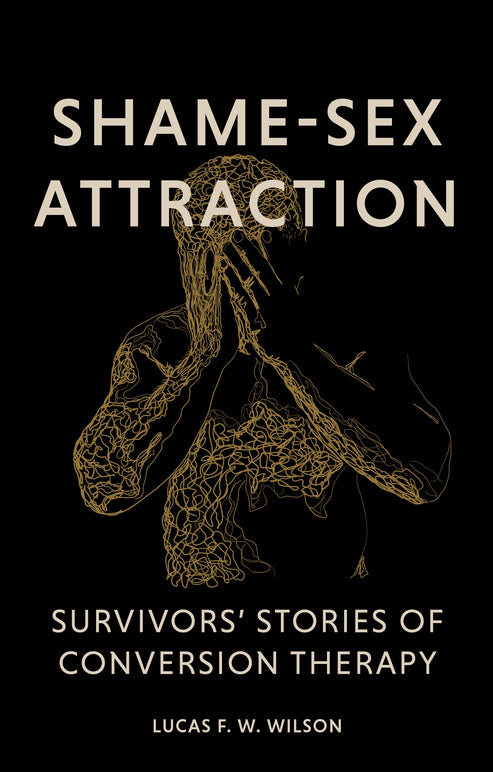
Along comes Lucas Wilson to have compiled a book on the topic which is marvellously well done, and deserving of a place on every bibliography devoted to conversion therapy and other ideologically driven destructive pseudo-treatments:  Shame-Sex Attraction: Survivors' Stories of Conversion Therapy (Jessica Kingsley Publishers, 2025), 192pp. 

I contacted him by e-mail to ask for an interview about the book. Here are his thoughts.

AD: Tell us about your background

LFWW: I grew up in a home with a dad who was an agnostic and a mom who, as I say now, was haunted by her Baptist demons. We were not a Christian family by any means, even if we went to church in the early years of my life. In fact, by grade three or so, my family—like all good Canadian families—went to the cottage rather than church. But when I was just about to enter high school, I became interested in questions of faith, and by the time I was in grade nine, I became a zealous evangelical and remained so for just over ten years (until I deconverted around age 27). When it came time to choose which college I would attend, I chose to study at the world’s largest evangelical college: Liberty University, Jerry Falwell’s school, located in Lynchburg, Virginia. It was there, on campus, that I underwent four years of conversion therapy—that which is now commonly referred to as conversion practices. 

After leaving Liberty, I went on to graduate school and received a proper education. Most of my academic training was in literature, but as time went on, I became increasingly interdisciplinary, working in the fields of religious studies, history, and creative writing. My work has largely centered on the Holocaust, but given the rise in anti-queer and anti-trans violence, public policy, and legislation, I redirected my attention on a main catalyst of homophobia and transphobia today: white Christian nationalism.

AD: Your other recent publications seem to be in the field of Holocaust studies . Tell us a bit about those works and what, if any, connections exist in your mind between them and this new book on so-called conversion therapy.

LFWW: Both the Holocaust and conversion therapy are inextricably connected to Christianity. The Holocaust never would have happened, as it did at least, had it not been for Christianity. Both the Christian scriptures and Christian theology laid the seedbed for the Holocaust—so much of the hatred against Jews that was in circulation before and during (and after) the Shoah was a function of Christian antisemitism. As for conversion therapy, efforts to change individuals’ nonnormative sexualities and genders were enthusiastically supported and promoted by Christians since at least the 1970s; although conversion therapy began in secular contexts, it became something that has occurred disproportionately in conservative Christian contexts. Christianity has played a significant role in both of these sustained attacks on minority groups, and my research on these topics addresses the ways by which Christianity has so easily lent itself to such hatred. 

Of course, there are also many differences between these two areas of research, but despite these differences, my work in these two areas shares a number of theoretical and methodological similarities. Not only do I employ feminist and queer theories of affect, memory, and trauma in almost all my work, but I also approach my research subjects largely by way of oral history, archival collections, and literature. As my approaches to both areas of research overlap significantly, my goal is always the same: to center and amplify marginalized voices in order to better understand underrepresented individuals and groups, especially those in politicized religious contexts.

AD: What led you to write this book in particular on conversion therapy? 

LFWW: I’ve been writing and speaking about conversion therapy for a few years now. Because of this work, in concert with my involvement in the fight against conversion practices in Canada, I was invited by the fabulous Alex DiFrancesco (who became my editor) to edit Shame-Sex Attraction, an anthology of stories about conversion practices as told by survivors themselves. We thought it was important for all the stories in the collection to be written by survivors themselves; representation of conversion therapy has not always centered survivors, and we wanted to make sure that this collection elevated their voices. So, we only included survivors in Shame-Sex Attraction

AD: In your introduction you not only argue that conversion therapies are ineffective, fraudulent, and harmful, but also practices that are motivated by "genocidal intentions."  Some, I expect, might question such language. Can you elaborate on what you meant?

LFWW: This language and argument is original to two rockstar academics whose work I love: Christine M. Robinson and Sue E. Spivey. Though I can’t take credit for this language or argument, I draw upon both Robinson and Spivey’s research in almost all the work I do on conversion therapy, including in the introduction of Shame-Sex Attraction. Put simply, conversion therapists’ desire is for queers not to exist. Indeed, their goal is to eradicate any and all queer and trans representation, vitality, and life. That is, if conversion therapists could have their way, they want to see an end to me, LGBTQ2S+ communities, and queer and trans culture totally and completely. Such a desire is, definitionally, motivated by genocidal intentions. Although some supporters and practitioners of conversion therapy would not want us physically dead—though I am sure many do—genocide does not always aim to physically eliminate people. As has been well-established (especially in regard to Indigenous folks in North America), genocide can also be cultural.

AD: In your introduction especially you give a good overview of the literature on conversion therapies and the awareness of the harms these practices cause, noting that most of the practices still endure today "especially in religious spaces." You hint at some diversity here, but do not go into detail. Are there, to your knowledge, any religious traditions that refuse to engage in conversion treatments or have denounced them?

Yes! There are a number of religious traditions that are not complicit in conversion practices and that actively advocate against the harmful efforts to change queer and trans folx’s sexualities and genders. These are mostly more progressive mainline Christian and Reform Jewish congregations. The sad reality is, however, that many conservative religious traditions continue in their attempts to change queer folx’s genders and sexualities, despite these progressive religious traditions doing the good work they do. 

AD: In looking at national data of those forced to undergo conversion practices, you highlight that "specific minority populations" (p.17) undergo such practices at much higher rates. Any thoughts on why this might be the case?

LFWW: There are a number of complicating factors as to why minority populations are disproportionately targeted. Insofar as many of these folx face increased barriers to education, appropriate healthcare, and other resources, they are more vulnerable to conversion practices. If we think of trans folx specifically, there are numerous challenges they face in regards to receiving proper gender-affirming care. Many trans and nonbinary folx are moreover pushed into conversion therapy in religious contexts because their gender expressions do not allow them to pass; when these individuals were raised in religious families and communities, they were not always able to hide their non-normative genders and were thus more prone to conversion practices. 


AD: You note that "in 1952, homosexuality was listed as a mental illness in the first edition of the...DSM" (p.19). Numerous scholars (Robert Corber, Craig Loftin, Dagmar Herzog, inter alia) have suggested that these clinical decisions were not really driven by science but instead by the politics of the Cold War. What are your thoughts on that?

LFWW: No doubt, there were political factors that shaped the classification of homosexuality as a mental illness in the DSM. There were also social factors like the diffuse cultural homophobia that was in cultural circulation at the time, which made it seem obvious or natural that homosexuality was an illness. But with Alfred Kinsey’s early work in the 1940s, there was already research to suggest that homosexuality was not a mental illness. Shortly after the DSM came out, Kinsey’s next study, along with the work of Evelyn Hooker and others, further refuted this pathologization of homosexuality; however, it was not until 1973 that homosexuality was removed from the DSM. Indeed motivated by political and social politics of the time, this declassification of homosexuality came 21 years too late.

AD: You note that in the 1970s, when "Christian ministries emerged for queer individuals to become straight" (p.20) they were focused on the "transformative power of Jesus" and thus "did not draw on psychological 'explanations' of homosexuality until the 1980s." Have you looked at those programs from the 70s? I'm very curious as to what they consisted of. I'm equally wondering about your thoughts on why they made the turn to psychological explanations in the following decade? What might have motivated that?

LFWW: I have looked at the 1970s programs, albeit only briefly (there has not been an abundance of research on this subject and most of my research has centered on the later aspects of conversion practices). I am familiar with Chris Babits’ work that has focused on Kent Philpott, an early conversion therapist who relied heavily on the curative powers of the Holy Spirit and exorcisms throughout the 1970s. Like Philpott, the early conversion-therapy programs relied heavily upon prayer and faith, and both prayer and faith remained main aspects of conversion practices for many years. 

However, as I explain in the book, by the 1980s they were incorporating so-called psychological explanations for queerness into their teachings. I think the main reason for this was the symbiotic relationship ex-gay ministries and ex-gay “researchers” that the two groups formed. The ministries gained ostensible legitimacy because they had supposed psychological “research” to back up their claims, and the “researchers” (a dubious term to use in regards to these folks) got paid for their books, seminars, and conferences for which the ministries were paying. This is certainly a large reason for what motivated the psychological turn. 

AD: I've edited international scholarly collections and one hallmark is often an enormous diversity in individual chapters, but what I find striking in yours is a certain "uniformity" in that all the chapters resist being tied up in a neat, nice little bow at the end, allowing the reader to go away with a comforting ending. Was that an explicit editorial direction you gave to contributors?

LFWW: This was an explicit editorial direction, yes. I wanted readers to have to sit in the discomfort of what it is like to undergo conversion therapy. Obviously, this is a second-hand discomfort, and most folks (thankfully) will never know the depths of what it was like to be subjected to such dehumanizing practices. However, the endings were to disable readers from feeling some sort of narrative resolution or a sense that all was well for the authors after their time in conversion therapy. I think that we as humans (if I may make such a broad claim about all humanity) desire a sense of resolution when reading or listening to stories and that we often crave a happy ending. The stories’ endings in the collection, as abrupt and unresolved as they are, pointed to how, for survivors, our experiences were quite rough for quite some time. Although we eventually were able to come to terms with what happened to us, for a long time we had really unresolved and difficult times piecing ourselves back together. The stories’ endings gave voice to this, even if indirectly or in a small way. 

AD: The cumulative effect of such abrupt endings is, for me at least, a sharp awareness of the ongoing suffering of those who endured conversion therapies. This, in turn, gives rise to two questions: what do you find people need to recover from conversion "therapies"? Are there common things that many or even most people find helpful?

LFWW: In a Canadian study of conversion practices from a few years ago, that which was most helpful for survivors to recover and come to terms with their experience was friendships with affirming people, followed closely by friendships with 2SLGBTQ+ individuals. In other words, community is wildly important. Of course, therapy is always a good idea (for survivors and non-survivors alike), but not everyone can afford it. However, friendships are free, and a supportive community is of utmost importance to heal. 

AD: You note that your contributors are from North America and Australia, and mostly experienced conversion treatments in Christian contexts. Are there researchers out there you are aware of looking at conversion practices in the global south--Africa especially? (Some churches in Nigeria and Uganda have been especially virulent in their homophobia and promotion of the idea of "converting" from such a "sinful lifestyle".) And are there conversion practices in Islamic and other religious traditions that you know of?

LFWW: Yes, there are researchers who are doing work on conversion practices in the Global South; however, the majority of research focuses on such practices in the West. I think this is a major issue because conversion practices are ubiquitous and happen everywhere. Wherever there is religion, there are conversion practices (including in Muslim contexts). Though I hope the research on conversion practices in the West continues, I am even more eager to see the body of research on conversion practices in the Global South grow—not to mention research specifically on conversion practices in Muslim contexts. 

AD: Sum up your hopes for the book.

LFWW: I would love (and I mean love) for this book to change the minds of conversion practitioners and those who endorse conversion practices—to show them how death-dealing it is to try to change others’ sexualities and genders. I want to show them the immense psychological, emotional, and spiritual harm such practices cause. But I also know that the vast majority of conversion practitioners and their supporters will never read this collection, and even if they did, it would likely not change their minds—these folks do not have the ears to hear or the eyes to see that what they are doing and/or supporting is wrong. As such, I know this desire for them to change their minds after reading this work is a pipedream. 

In either case, I hope that survivors of conversion practices find this book and that they see themselves in its pages. I hope this book offers them solace in that they are part of a group that has persisted despite countless attempts to erase us. And I hope this book reminds them that they are nothing short of beautiful, strong, and resilient—that they are in fact survivors.

AD: Having finished this book, what are you at work on now?

I am currently working on another edited collection, this one about queer experiences at Christian colleges, universities, and seminaries. I am accepting submissions until April 15, so if anyone is interested in submitting a story, I invite them to e-mail me!

Sexualities and Identities:

It is the fate of collections to be often wildly uneven, and that is true with Sexualities: Contemporary Psychoanalytic Perspectives, eds. Alessandra Lemma and Paul E. Lynch (Routledge, 2015), xiii+244pp. There are two outstanding chapters, and two very good chapters; and then a great deal of other material some readers might find interesting or helpful but I did not. 

I read this book first for general interest, then because I work with adult and adolescent sex offenders ordered by the courts into treatment, and finally because I am working on an essay about the erotic in transferences and counter-transferences. 

I begin with Part III, "Homosexuality" and the first essay in this section by Peter Fonagy and Elizabeth Allision, "A Scientific Theory of Homosexuality." To my mind, this is the most outstanding essay in the book both for the cogency of the writing and for the challenging arguments it offers. The entire chapter--or at least the first half of it--plays something of a trick on the reader who, under that title, is led to expect something the authors very severely put to the question in the chapter's second half. That is, the first part is a brief review of the history of attempts to conjure up a theory of homosexuality (that history has recently been treated more expansively, but not entirely successfully, in a book I discussed here). 

Fonagy, of course, is the founder of the tradition of mentalization-based therapy, about which see here and here. He has also published on possible connections between infantile experiences and attachment, and the development of sexuality. 

With Allison, the burdern of the second half of their co-authored chapter is introduced and encapsulated by the claim that "normal sexual desire is inherently unknowable....Part of the essence of desire is that there is something anti-conceptual, something indefinite and unknowable about it" (p.133). This, in turn leads to one of the other major claims by these authors: "neither homosexuality nor heterosexuality are 'normal' and...neither can be an identity."

I rather imagine that both claims will immediately set some teeth on edge, but both are for me so straighforwardly obvious and true they cease to require additional argumentation. 

These claims are not, of course, entirely original to these two authors. Adam Phillips, for one, has argued something similar about the inherent unknowability about sexual desire and identity, especially in his 1997 book Terrors and Experts, where he has repeatedly noted that "there is nothing like sexuality...for making a mockery of our self-knowledge. In our erotic lives, at least, our preferences do not always accord with our standards." Later in the book he continues by arguing that "from a psychoanalytic point of view, nobody can know about sexuality" in part because "we are never one thing or another, but a miscellany. (For how long in any given day is one homosexual or heterosexual, and can you always tell the difference?)" 

The, uh, desire to have definitions and identities clearly nailed down is, Phillips suggests, an expression of our "wish to be defined [which] is complicit with the wish to be controlled." Additionally, the ham-fisted insistence on clear and sharp definitions runs the very real risk that "too much definition leaves too much out." Too much definition, in other words, undermines mystery and freedom alike. 

This, too, is very similar to what Fonagy and Allison argue: "the essence of desire is its indefiniteness." Indefiniteness means that we can have no legitimating theories of human sexuality, and these authors end their essay by suggesting that such theories in the past have functioned in an anti-mentalizing fashion, shutting down the ability to think about ourselves in ways that take account of our complexity and messiness: "it behooves us to be suspicious of ourselves when our wish for simplicity begins to override out respect for the complexity of subjective experience that our patients engender and bring with them in relation to their experience of their sexuality" (p.135). 

Anyone who has done clinical work for more than a week will immediately realize the profound truth of that last statement. And it shows up in several other essays, as well, including the moving and somewhat melancholic "Intimacy and Shame in Gay Male Sexuality" by Paul E. Lynch: "the beauty of working with patients instead of theories is that they are not so determinedly insistent on conclusions about their own sexuality, and are more often trying to find some way to make sense of themselves, their bodies, their pains and pleasures, and their relationships" (p.146). (Briefly towards the end of his chapter, Lynch suggests that "transgressive sexual behaviors may be an enactment or embodiment of un-represented, un-symbolized, or unformulated early experience," a theme that Adam Phillips has also briefly touched on, and before them both found in the works of Robert Stoller, including Perversion: the Erotic Form of Hatred.)

Earlier in the collection, Mary Target suggests that "fully expressed adult sexuality, regardless of dominant gender identity or orientation, incorporates unconscious bisexuality and bluring of the gender role of self or other." All of these authors, of course, are merely echoing what Freud first postulated in his infamous 1905 Three Essays on the Theory of Sexuality:

Since I have become acquainted with the notion of bisexuality I regarded it as the decisive factor, and witout taking bisexuality into account, I think it would scarcely be possible to arrive at an understanding of the sexual manifestations that are actually to be observed in men and women.

Lynch's claim about un-represented forms of sexual desire and behavior shows up in the last two chapters of this collection, the first written by Avgi Saketopoulou, who has also recently published Sexuality Beyond Consent, which I hope to read over the Christmas break. Her chapter here is entitled "On Sexual Perversions' Capacity to Act as Portal to Psychic States that Have Evaded Representation." 

She grapples with the continued use of the word "perversion," before arguing that we might retain it because it "captures the phenomenology of sexuality that blends anguish and/or pain with pleasure." Those who work clinically, as I do, with patients whose desires have been judged (often by courts, but sometimes by parents or themselves) as perverse and illegal know well this unique, and uniquely difficult, blend of anguish and pain: the desire that is unwanted, that has brought such trouble and left a streak of such devastation, is also a desire not without a certain frisson. Rather than condemn all such desires a priori and totally, we must, if we are to be of any help clinically at all, recognize that in some cases there may be real attempts to grapple with things that were unthinkable to the developing mind. As she puts it, "some sexual perversions...may be understood as proto-attempts towards figuration" (p.214). In the process of trying to figurate such experiences and desires, we must, she concludes, "always be aware" that some things are "eternally inaccessible to us, impossible to bring into knowable experience." Once more those with even modest clinical experience will at once recognize this as true.

Finally, Heather Wood concludes the book with her "Working with Problems of Perversion," and takes a much more practical approach, showing how many and how often perversions function as defensive measures to keep at bay the ever-threatening peril of intimacy and its possible engulfments. Drawing on Glasser's earlier work, Wood argues that "sexual perversions have very little to do with sex...but are about the use of sexualization as a defence to deal with primitive terrors in relationships" (p.224).  Such terrors include an uncertainty about whether the patient's own aggression can be controlled in a relationship or whether it will give rise to sadism and destruction. 

Wood also offers some helpful counsel about working in the transference with such patients, and dealing with counter-transference reactions. Many of us are anxious about sexualized transferences, and perhaps even more sexualized counter-transferences (a topic I'm writing a paper about just now), but she calmly suggests that if we keep in mind her claim above--that sexualization is a defense mechanism like other defenses--it should help us be less anxious about it. We must still, however, examine closely our own reactions as well as the transference to see whether they are about: control? sadism? anxiety? intrusion? seduction? taming a frightening object? fear of abandonment? a defense against destructive urges? a desire for merger which is intolerable and must be defended against? 

In some cases, Wood suggests, after the above forms of sexualization have been worked out, one occasionally might then begin to see less defensive sexual feelings emerge toward the clinician: "it may be important that these feelings are tolerated rather than viewed as defensive if true integration of sexuality and dependency are to occur" (p.228). 

This note has only touched on some of the essays in this rich collection. Anyone interested in sexuality and psychoanalysis will want to have this book on their shelf. 

Psychoanalysis and Homosexuality

This short new book, Psychoanalysis and Homosexuality: A Contemporary Introduction (Routledge, 2023, vii+164pp.) by two British clinicians, Leezah Hertzmann and Juliet Newbigin, is something of a useful handbook of (select) sources. It would be helpful to have on hand to refute those who still wish to criticize Freud and associate to him what are demonstrably later and far less felicitous attitudes towards homosexuality, which he never held. Such (often tendentious) criticism is rather tiresome and has long been known to be baseless by those of us who have actually read, and still regularly re-read, Freud (as I have done since 1990), either in German or in the authorized translation, or both. 

Hertzmann and Newbigin's book reads, in part, rather like a graduate student's lit review as part of a thesis requirement. The authors have provided decent lashings of (select) primary source material (always in translation, of course) farced not with scholarly analysis but rather with commentary of their own, which has its place. The style is admirably and immediately accessible and clear.

My hesitation with this book is threefold: first, it is never clear how they chose to pay attention to some figures and not others. It is never good to leave your readers guessing about your selection criteria. To my amazement, the radical views of Sandor Ferenczi (so much so that Freud himself, very "liberal" in his day on this question, was made uncomfortable by them) on homosexuality show up nowhere in this book.  It would have been good, at the very least, to have a look into Sandor Ferenczi: Reconsidering Active Intervention by Martin Stanton. Other important figures from that first generation--which, as a whole, was far more "liberationist" than their reactionary heirs in postwar America--are also overlooked. Why?

Second, the book attends in no significant way to significant historiographical issues in the composition and context of the texts they choose to include, and in those they exclude. I teach my history of psychology class every fall, and attending to how and why that history is written, and by whom--who is in, who is out, who does the choosing, and what are the subterranean currents to this choosing and composing we need to listen for with our third ear--is at least as important as any question of what was written. 

From this follows my third concern: the book pays insufficient attention to sociopolitical factors, especially in the United States in the postwar (=Cold War) period, where many of the developments we can now rightly deplore in psychoanalysis took root with a vengeance. Though these authors indicate a nodding familiarity with Dagmar Herzog's book Cold War Freud, they have not sufficiently integrated her arguments into this little book (or those of other scholars who are relevant here, including Todd McGowan and Paul Roazen)

The problem--as Freud foresaw as far back as 1909--was that on questions of sexuality in general, America was a puritannical and hostile nation that could not handle his ideas. And this was confirmed after his death in 1939 and the end of the war in 1945 when American attitudes (many of them politically driven) towards many things argued by Freud were disastrously distorted or abandoned, including such things as the restriction of analysis to physicians (which he strongly denounced in The Question of Lay Analysis) and the rise of psychoanalysis as an ideology (the best recent book here is Adam Phillips, The Cure for Psychoanalysis) with orthodox beliefs and practices rigorously policed and enforced by training institutes that often existed in a state of excommunication from each other) rather than a method of treatment. Those institutes, of course, came to exclude homosexual candidates from training. 

Now, it is rightly objected--as I have objected in the past as both editor and reviewer--that one must not unfairly criticize authors for not having written the book the reviewer thinks they should have while overlooking the book they did in fact write. That would be a valid objection here if--again--we were given any sort of rationale for how this book was written, or what the purposes of composing this highly selective, almost idiosyncratic text were. It is certainly not a systematic or comprehensive history, but that does not deny its value and virtues, and the place it does fill as a very brief introduction to the topic. Scholars wanting a more thorough, searching, critical, historiographically sophisticated text will have to produce one themselves or wait for others to do so. 

Having offered such concerns, let me now end with some examples of the book's virtues. 

The third chapter does, in some ways, attend to postwar figures sometimes overlooked, including Sandor Rado who, with some of the Kleinians and others like Edmund Bergler, seem to have played significant roles in shaping views on homosexuality and trying to obtain a role in its "treatment." This chapter--drawing on Herzog--also notes (as more recent authors such as Andrea Celenza and Galit Atlas have done) that psychoanalysis as a whole became far less willing to consider the role of the erotic, in all its forms, and far more suspicious of it and intolerant of its ambivalences and ambiguities. 

The final chapter of the book is the richest, and here the authors turn again to the problem of the exclusion and suspicion of sexuality across the board in clinical work, noting--as others such as Celenza, Atlas, Maroda, and Gabbard have done--that most training programs deal insufficiently or not at all with questions of erotic transference and counter-transference, but that such questions are even more defended against when "the patient's sexual or gender orientation is different from that of the therapist" (p.133). Thus, they argue, one of the challenges going forward is to more fully recognize non-heterosexual forms of desire and how they show up in, and have an impact upon, treatment.